

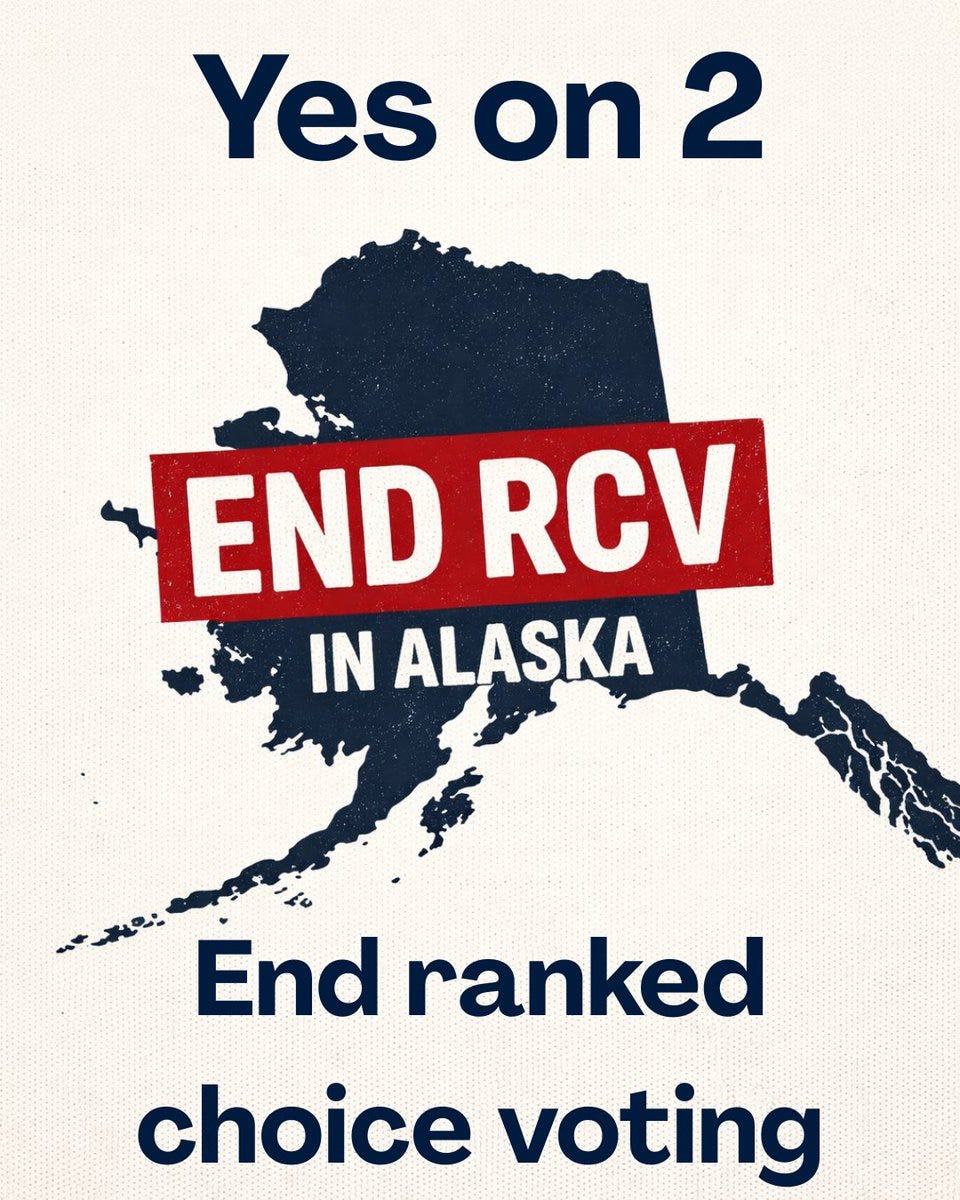
This November, Alaskans vote on our election system for the third time in six years.
Three votes in six years. Why? Because the first two didn’t settle anything. In 2020, Ballot Measure 2 passed by 3,781 votes. In 2024, the repeal failed by 743 votes. Out of more than 320,000 ballots cast.
Those are the numbers of a system Alaskans never really wanted. It only survives because somebody keeps paying to keep it alive.
Who is that somebody, and what does this system do to our elections, our candidates, and our votes. I’ve written about ranked choice voting many times. This piece puts the whole case in one place. It’s simple, and you don’t need a law degree to follow it. In fact, the people defending this system are counting on you not to follow it.
They think we’re stupid. We’re not.
The Short Story
Ranked choice voting trains candidates to hide what they believe and lets a computer algorithm throw out legal ballots. It just handed us two Dan Sullivans on one Senate ballot.
It was never an Alaskan idea. A tiny club of Outside billionaires paid for it: John Arnold, the former Enron trader; Kathryn Murdoch, Rupert Murdoch’s daughter-in-law; and Pierre Omidyar, the eBay founder who has spent over half a billion dollars trying to re-engineer how Americans vote.
They outspent Alaskans 12 to 1 to pass it in 2020 and more than 100 to 1 to save it in 2024, with millions flowing through a Virginia group that hides its donors. The law they sold as a dark money ban is defended by dark money. And the lawyer who wrote it, Scott Kendall, uses his own rules to fine the Alaskans trying to repeal it.
In 2024 repeal lost by just 743 votes. This November we finish the job. Vote YES on the new Ballot Measure 2. The receipts are below, every claim linked to its source.
Part One: What RCV Does to Candidates
Start with the basics. A republic works when candidates tell you what they believe, and you pick one. Clear choices. Clear results.
Ranked choice voting breaks that.
Under RCV, a candidate can’t just win your first choice vote. He needs second and third choice votes from people who disagree with him. So what does he do? He goes quiet. He softens his message. He blurs his positions. If he says something strong about life, guns, or spending, he loses those second choice votes. So he learns not to say it. That’s not moderation. That’s dishonesty built right into the rules. I call it political camouflage.
Look at Australia. A hundred years of ranked voting has left them two big parties that sound exactly the same. Different labels, same product. When every candidate is a shade of beige, voters stop picking the strongest ideas and start picking the most polished face. That’s where this road ends: a uni-party of interchangeable winners.
Our founders were not beige. They were stubborn, difficult, and clear, and their bold ideas built the strongest, freest country on earth. A voting system that punishes conviction isn’t a reform. It’s a slow poison.
Part Two: What RCV Does to Your Vote
The old way was simple. One person, one vote. Most votes wins. You could count it yourself.
RCV replaces that with a computer algorithm. Your ballot gets shuffled through rounds of elimination that you can’t watch and can’t check. And here’s the part they don’t advertise. If you don’t rank enough candidates, your ballot can get thrown out along the way. They call it an exhausted ballot.
Your vote is extinguished. Gone. You followed the rules. You voted legally. Yet your ballot isn’t in the final count. Then the winner claims a majority. But it’s a majority of only the ballots left after the machine finished with them. That’s not a real majority. That’s math dressed up as one.
And notice what candidates say now. If I can’t be your first choice, rank me second. I’m not that bad. Campaigning for second place is like a participation trophy. That’s not the Alaska way, and it’s not the American way.
Part Three: The Two Dans
Think I’m exaggerating? Look at what’s happening right now.
A second man named Dan Sullivan filed to run for U.S. Senate against Senator Dan Sullivan. The Division of Elections kicked him off. He sued. Now judges are racing ballot printing deadlines to sort out a race that could help decide control of the U.S. Senate.
The decoy isn’t the problem. The system is. Before 2020, to run as a Republican against a Republican senator, you had to beat him in a Republican primary. Republican voters were the gatekeepers. Ballot Measure 2 ripped that safeguard out. Now anyone can slap Republican next to his name, and the state itself admits the label means nothing. No endorsement. No vetting. Just two Dans on one ballot, waiting to hijack your ranking.
The system they said would end political games invented a brand new game. Now bureaucrats and judges, not voters, decide who gets on your ballot.
Part Four: Follow the Money
Who paid for all this?
Not Alaskans. Not even close.
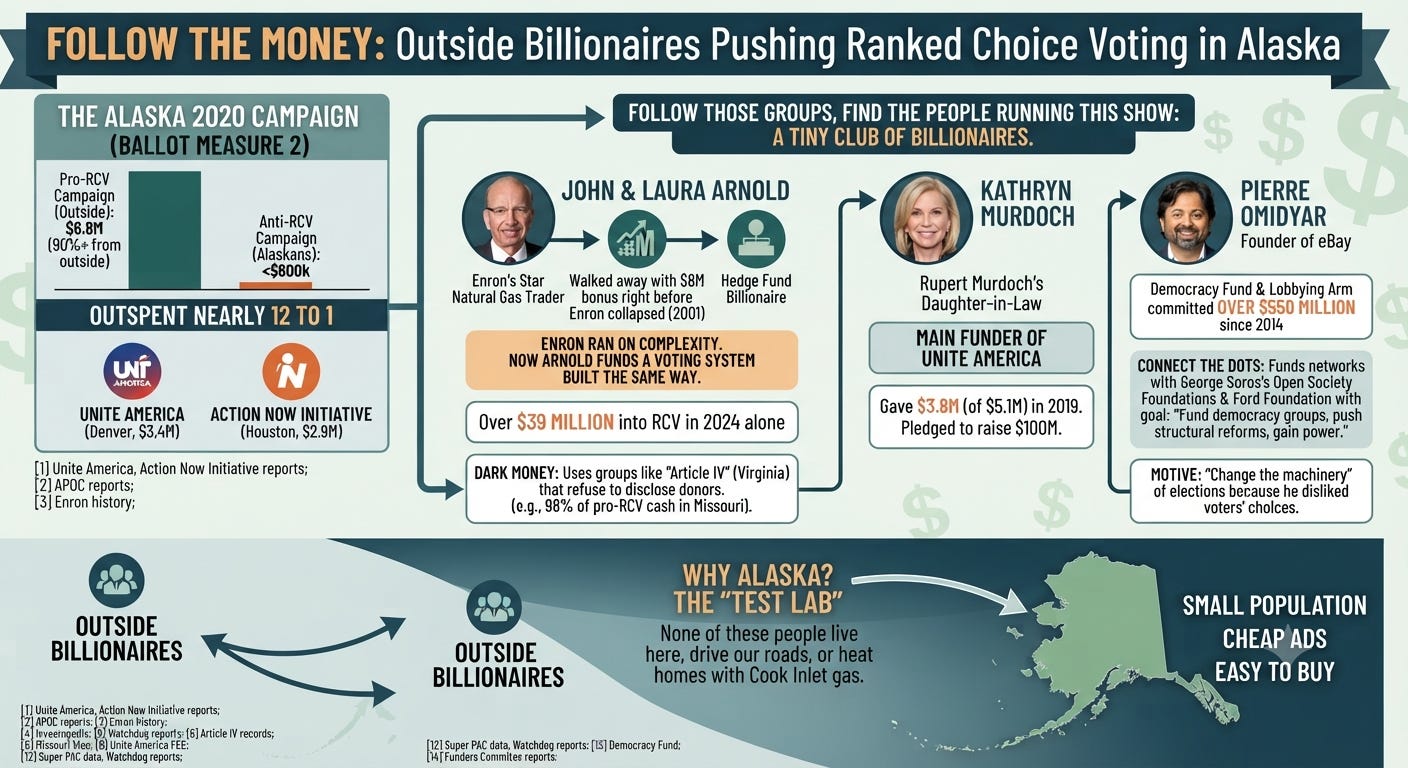
The 2020 campaign for Ballot Measure 2 raised 6.8 million dollars. More than 90 percent came from just two Outside groups: 3.4 million from Unite America in Denver, and 2.9 million from the Action Now Initiative in Houston [1]. The opposition raised under 600,000 dollars, mostly from real Alaskans [2]. Outspent nearly 12 to 1.
Follow those groups and you find the people actually running this show. A tiny club of billionaires.
John and Laura Arnold. John Arnold made his fortune as Enron’s star natural gas trader [3]. If Enron doesn’t ring a bell, look it up [4]. Enron hid billions in debt behind accounting so complex almost nobody could follow it. When the truth came out in 2001, the company collapsed. Twenty thousand people lost their jobs. Thousands of employees lost their life savings. Arnold was never accused of any wrongdoing. But he walked away with an 8 million dollar bonus, the largest in Enron history, right before the bankruptcy. He used it to start the hedge fund that made him a billionaire.
Here’s what sticks with me. Enron ran on complexity nobody could check. So does ranked choice voting. When a system is too complicated to follow, insiders win and everyone else pays. Arnold watched that lesson up close. Now his fortune funds a voting system built the same way. By one watchdog’s count, the Arnolds put about 39 million dollars into RCV ballot campaigns in 2024 alone [5]. They move money through several groups, including one called Article IV in Virginia that refuses to say where its own money comes from [6]. Dark money. In Missouri, over 98 percent of the pro-RCV campaign cash came from a group called Article IV [7]. Remember that name.
Kathryn Murdoch. Rupert Murdoch’s daughter-in-law. She’s the main funder of Unite America. She gave 3.8 million of the 5.1 million it raised in 2019 and has pledged to help raise 100 million for its agenda [8].
Pierre Omidyar. The founder of eBay. Born in Paris to Iranian immigrant parents, his foundations have poured millions into FairVote, the national RCV flagship. But with Omidyar, the money is only half the story. The other half is why. And the why should worry every Alaskan.
Start in 2016. Omidyar gave 450,000 dollars to super PACs working to stop Trump from winning. His Democracy Fund Voice gave another 250,000 to Stand Up Republic, the anti-Trump group run by Evan McMullin [12]. Then came the explosion. Since 2014, his Democracy Fund and its lobbying arm have committed over 550 million dollars, every dime from Omidyar himself [13].
Where does it go? His Democracy Fund sits in a funding network called the Funders Committee for Civic Participation, right alongside George Soros’s Open Society Foundations and the Ford Foundation. That network publishes its own playbook, and the playbook is blunt: fund democracy groups, push structural reforms, gain power [14]. Their words, not mine. And watchdogs who tracked the grants found they flow overwhelmingly to one side, despite the bipartisan branding [12].
So connect the dots. Omidyar looked at elections where voters picked candidates he didn’t like, and he decided the voters were the problem. He couldn’t win the argument. So he’s spending half a billion dollars to change the machinery instead. Ranked choice voting is one of his fixes. It’s not a fix for democracy. It’s a fix for you.
George and Jonathan Soros have given money too. But their role here is small compared to the others. This movement doesn’t need them. It has richer friends.
None of these people live here. None of them drive our roads or heat their homes with Cook Inlet gas. But they picked Alaska as their test lab. Small population. Cheap ads. Easy to buy.
They thought.
Part Five: One Hundred to One
In 2024, Alaskans gathered signatures and put repeal on the ballot. The empire struck back.
The campaign defending RCV raised almost 14 million dollars. Where from? 5.5 million from Unite America. 4.4 million from Article IV, the Virginia group with secret donors. Two million more from Action Now [9].
The repeal side raised about 117,000 dollars. No single donation over 10,000 dollars. Just Alaskans chipping in fifty and a hundred bucks at a time.
That’s more than 100 to 1, the most lopsided campaign in Alaska history.
And Alaskans almost won anyway. Repeal failed by a mere 743 votes. That number should scare them. It means their money isn’t buying belief anymore. It’s just barely buying time.
Standing in the middle of it all is one Anchorage lawyer: Scott Kendall. He wrote Ballot Measure 2. He defended it in court. His firm is still the campaign’s counsel today. The billionaires fund the national groups. The national groups fund the Alaska campaign. The Alaska campaign retains Mr. Kendall. He even used the disclosure rules he wrote to win about 95,000 dollars in fines against the volunteers trying to repeal his own law [10]. And he’s not done. This month he filed fresh complaints against the 2026 repeal campaign [11].
His side gets 14 million and a law firm. Our side gets complaints filed against it.
Part Six: The Dark Money Lie
Here’s the part that should enrage every Alaskan.
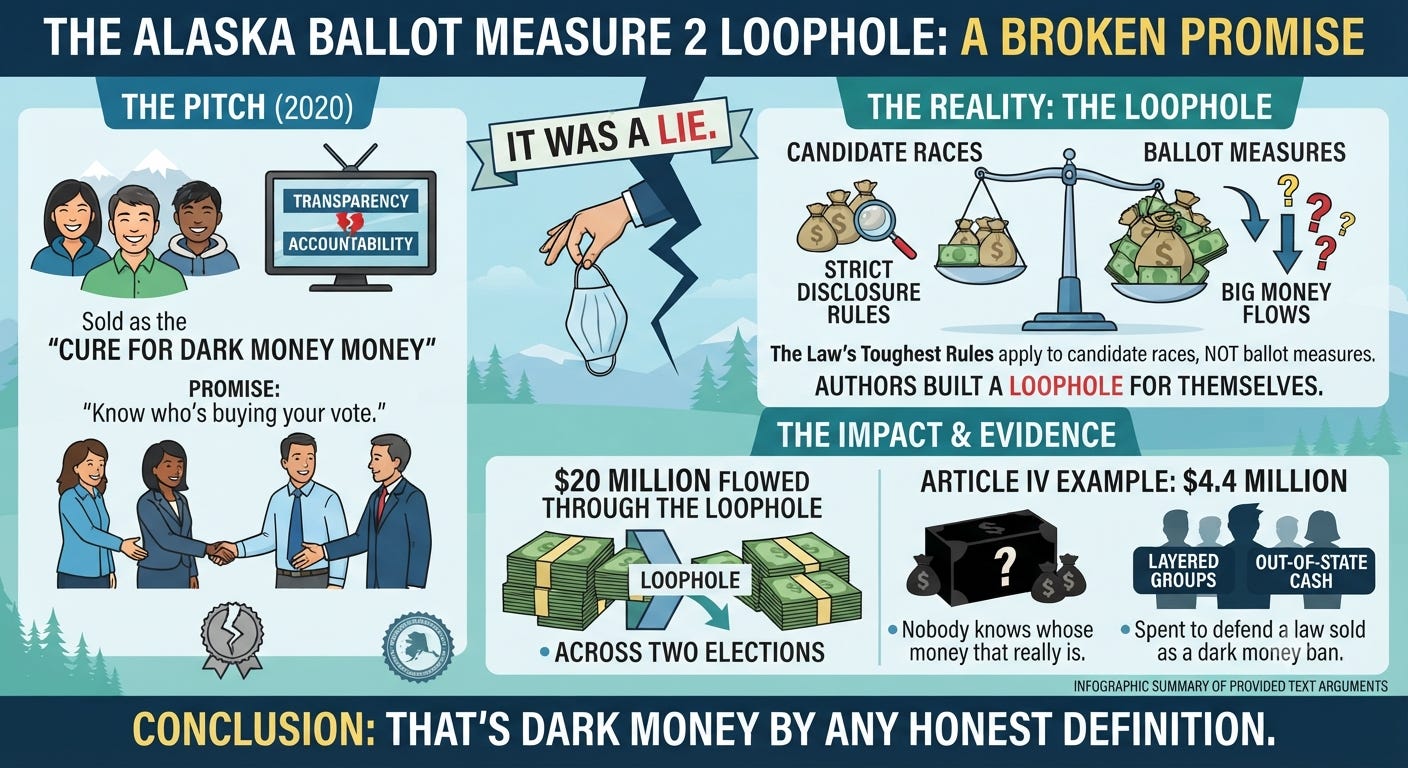
Ballot Measure 2 was sold as the cure for dark money. That was the pitch on every ad in 2020. Transparency. Accountability. Know who’s buying your vote.
It was a lie.
The law’s toughest disclosure rules apply to candidate races, not ballot measures. Yet ballot measures are exactly where the big money flows. That’s not an accident. That’s the loophole the authors built for themselves. They’ve pushed roughly 20 million dollars through it across two elections.
And Article IV’s 4.4 million dollars? Nobody knows whose money that really is. Secret donors. Layered groups. Out-of-state cash. Spent to defend a law sold as a dark money ban.
That’s dark money by any honest definition.
The Legislature has tried more than once to close these loopholes with faster reporting and real limits on Outside money in ballot campaigns. The Democrat lead majority killed those amendments every time. The very people who campaign against dark money vote to protect it.
One more thing. Repealing Ballot Measure 2 doesn’t repeal disclosure laws. Alaska had campaign finance rules before 2020. APOC will still enforce them after repeal. What repeal removes is a rigged structure built by people who exempted themselves from their own promises. So don’t fall for the dark money sales pitch.
Part Seven: No More Excuses
For years, RCV defenders blamed everything else. Slow counts? Blame the Division of Elections. Confusion? Blame the voters. Rejected ballots? Blame paperwork. Everything but the root of the problem: rank voting.
Yes, some problems were real. Wrong ballots sent to Dillingham, King Salmon, and Aniak. A locked state bag with a completed ballot found in a ditch off an Anchorage road. Over a thousand legal ballots tossed for fixable clerical errors.
But those problems are being fixed. Voter rolls are being cleaned up. Audits and ballot tracking are coming online. And the state must now release the round-by-round RCV numbers so everyone can see exactly how the machine picked the winner.
Watch what happens next. Every excuse disappears. The system has to stand on its own. A confusing, conviction-punishing, Outside-funded algorithm that erases ballots and invites decoy candidates.
It can’t stand on that. That’s why they need the 14 million dollars.
The Choice in November
Let’s put it all together.
They spent 6.8 million telling us Ballot Measure 2 would stop Outside influence. It was the most Outside-funded campaign in state history at the time. Then they broke their own record defending it. They promised transparency, then ran millions through a Virginia group with secret donors. They promised civility, then gave us decoy candidates and emergency court hearings. They promised majorities, then gave us math.
They’re not reformers. They’re an Enron trader, a Murdoch, and an eBay billionaire running a science experiment. Alaska is the lab rat. And the lab rat keeps refusing to cooperate.
In 2020 they won by 3,781 votes. In 2024 they hung on by 743. They can buy every ad on your TV. They can’t buy your ballot.
Elections should reward courage and clarity. Winners should be chosen by voters, not assembled by algorithms. And Alaska’s elections should belong to the people who live with the results. Not to whoever writes the biggest check from four time zones away.
Vote YES on the new Ballot Measure 2. Vote YES to end this mess.
Let’s take our elections back.
Sources
1. Ballotpedia, Alaska Ballot Measure 2 (2020), campaign finance: https://ballotpedia.org/Alaska_Ballot_Measure_2,_Top-Four_Ranked-Choice_Voting_and_Campaign_Finance_Laws_Initiative_(2020)
2. Ballotpedia News, who funded the 2020 RCV campaigns: https://news.ballotpedia.org/2021/02/22/who-funded-the-campaigns-for-and-against-ranked-choice-voting-ballot-measures-in-2020/
3. InfluenceWatch, John D. Arnold profile (Enron career, bonus, no wrongdoing alleged): https://www.influencewatch.org/person/john-d-arnold/
4. Britannica, the Enron scandal explained: https://www.britannica.com/event/Enron-scandal
5. Carolina Journal (Honest Elections Project), Arnold RCV spending in 2024: https://www.carolinajournal.com/opinion/the-lefts-ranked-choice-voting-scheme-to-replace-honest-elections/
6. St. Louis Post-Dispatch, Article IV does not disclose its donors: https://www.stltoday.com/news/local/govt-and-politics/who-s-behind-effort-to-change-elections-in-missouri-a-couple-from-texas/article_71325b4d-503a-5cc9-870a-15c594fdd44c.html
7. Ballotpedia News, over 98 percent of Missouri RCV campaign funding from Article IV: https://news.ballotpedia.org/2022/04/27/campaign-for-ranked-choice-voting-ballot-initiative-in-missouri-has-raised-millions-ahead-of-signature-deadline/
8. InfluenceWatch, Unite America and Kathryn Murdoch funding: https://www.influencewatch.org/political-party/unite-america/
9. Common Dreams, 2024 No On 2 fundraising breakdown: https://www.commondreams.org/opinion/rank-choice-voting-states-2024
10. Anchorage Daily News, APOC fines over 94,000 dollars against repeal groups: https://www.adn.com/politics/2024/01/04/alaska-ranked-choice-voting-opponents-fined-over-94k-for-campaign-ethics-violations/
11. KTOO, July 2026, new campaign finance complaints against Repeal Now: https://www.ktoo.org/2026/07/10/group-seeking-to-repeal-alaskas-ranked-choice-voting-hit-with-campaign-finance-complaints/
12. InfluenceWatch, Democracy Fund (anti-Trump giving, left-of-center grantmaking): https://www.influencewatch.org/non-profit/democracy-fund/
13. Democracy Fund, over 550 million dollars committed, solely funded by Omidyar: https://democracyfund.org/who-we-are/
14. Capital Research Center, the Funders Committee and its theory of impact: https://capitalresearch.org/article/omidyars-political-machine-part-3/