


Speaker Mike Johnson was in Palmer today and said there are now 41 communists serving in the United States House of Representatives. That’s Speaker Johnson’s number, and he didn’t hedge about it. Nick Begich made the larger point. The socialists aren’t hiding anymore.
I know there are differences between communists, socialists, democratic socialists, and progressives. but I also think they are just different outhouses along the same communist hiking trail. What matters to me isn’t what somebody calls themselves.
What matters is where they want to take my country.
So I went to the Democratic Socialists of America and looked at what they actually want. Their new national program, Workers Deserve More, calls for government-funded health care, publicly owned housing, universal rent control, publicly owned energy and transportation, a federal jobs guarantee, a 32-hour workweek with full pay, aggressive wealth taxes, and public ownership of America’s largest corporations and essential industries. They want to abolish the Electoral College and the Senate, replace the President and Supreme Court with an executive subordinate to Congress, and eventually write a new constitution.
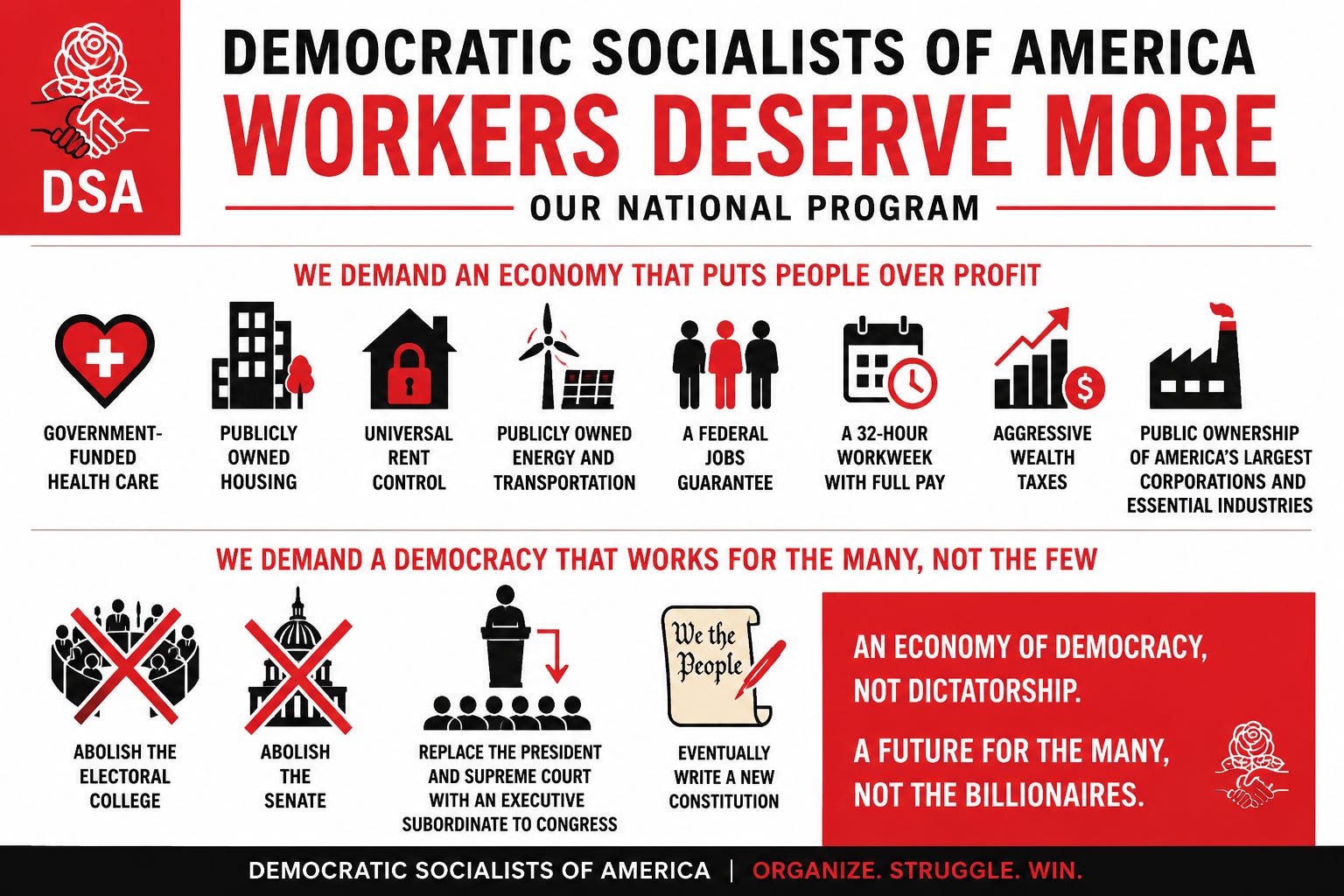
Nobody is hiding any of this. It is right there in their platform.
What concerns me is how normal these ideas have become. For most of my life, calling a politician a socialist was an accusation. Today politicians proudly run as democratic socialists and win. Ideas that would have been far outside mainstream American politics a generation ago are now debated in Congress as serious policy. The Overton Window has not just shifted left, it has departed scene – stage left – with extreme prejudice.
But here’s what’s interesting: socialism isn’t rising among working people. It’s rising among the educated elite.
C.S. Lewis understood this. In That Hideous Strength, he wrote about why utopian ideas spread through the educated class: “When did you meet a workman who believes the papers? He takes it for granted that they’re all propaganda and skips the leading articles… But the educated public, the people who read the highbrow weeklies, don’t need reconditioning. They’re all right already. They’ll believe anything.”

Working people are natural skeptics. They don’t trust grand promises from government. They’ve seen too many of them fail. They understand that somebody has to pay the bill. They know the difference between talk and reality. In the military we would say truth talks, bullshit walks.
Socialism spreads through universities, media, publishing, and government bureaucracies, institutions run largely by educated elites. It appeals to them because it flatters the assumption that if only smart people were in charge, we could plan society rationally. It promises that intelligence and good intentions can overcome human nature. Working people know better. They know good intentions don’t build houses, and smartness doesn’t change the fact that somebody still has to provide the land, labor, equipment, materials, and money.
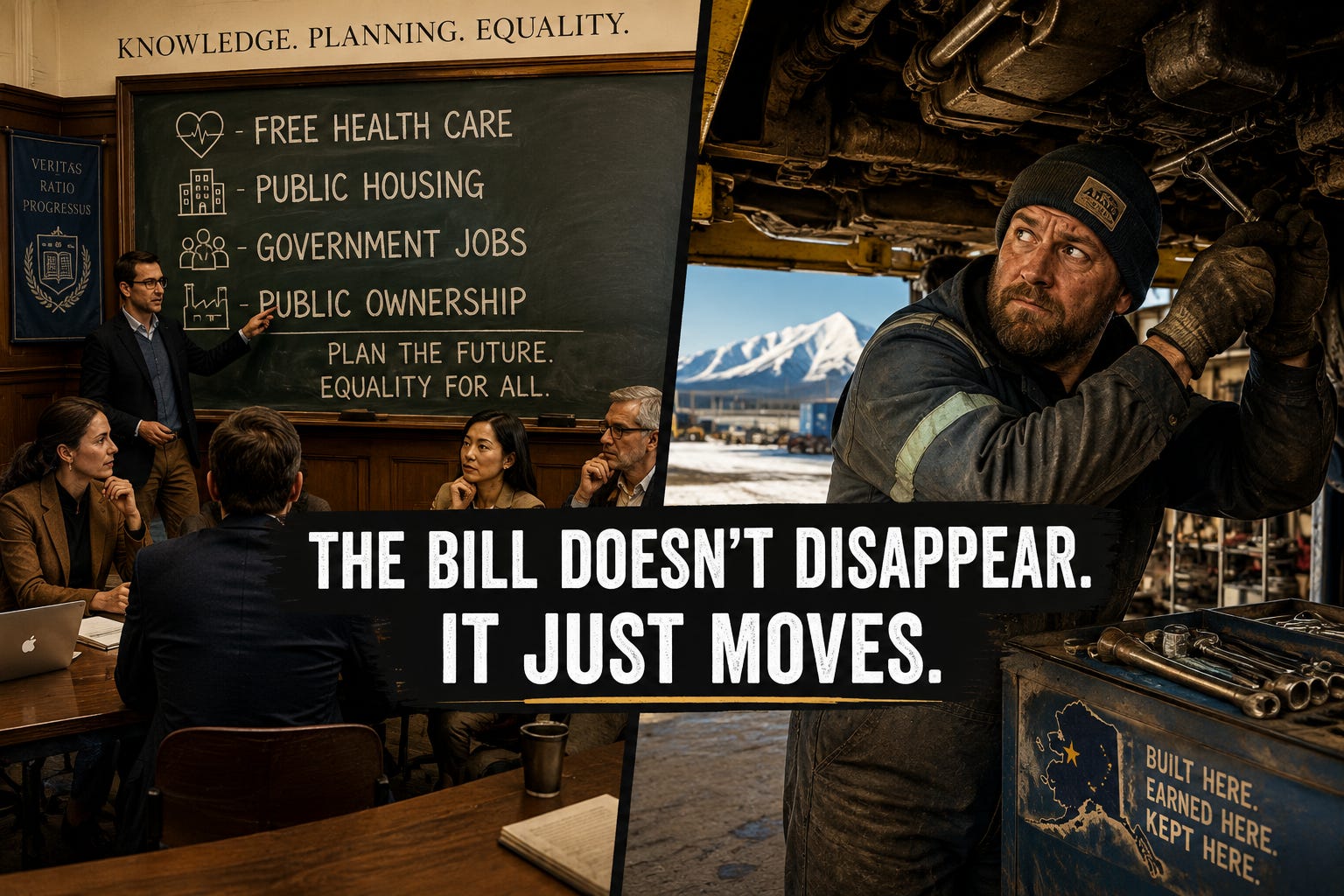
The bill doesn’t disappear. It just moves.
I think part of the reason educated people fall for socialism is that we raised a generation that knows plenty about the failures of capitalism and very little about the failures of socialism. Universities teach about robber barons, inequality, corporate greed, and exploitation. They should. Those things happened. But far fewer students seem to leave school understanding what happened in the Soviet Union, Cuba, China, Cambodia, and Venezuela.
Those countries were different, and their governments were different, but they shared the same basic mistake. They concentrated more and more economic power in government because government was supposedly going to make life fairer. Eventually economic power becomes political power, and the educated people who helped build the system often became its enforcers.
The promises always sound good. Free health care. Affordable housing. Guaranteed jobs. Cheap energy. Secure retirement. Who wouldn’t want those things?
The problem is that calling something a right doesn’t make it free. Declaring housing a right doesn’t build a house. Declaring health care free doesn’t educate a doctor or build a hospital. Declaring energy a public good doesn’t build a power plant. Somebody still has to provide everything.
That is where capitalism, with all its faults, has an advantage. Prices tell us what people need, what they value, and where more supply is needed. Profit gives somebody a reason to take a risk, invest money, hire people, and produce more. Sometimes businesses fail. Sometimes people get greedy. Sometimes markets get things wrong.
Compared to what?
Compare our imperfect system to the actual record of governments that tried to replace markets with government control. Venezuela has some of the largest oil reserves on earth, yet millions of Venezuelans have fled their country. Hugo Chávez didn’t campaign by promising poverty and authoritarian government. He promised fairness and a better life for ordinary people. The people running the system believed they could manage the economy better than markets could. Government took greater control, and political power followed.
America isn’t Venezuela, Cuba, China, or the Soviet Union. We have a Constitution, divided government, courts, elections, and private property rights designed to keep too much power from ending up in one place. But those protections only work if we understand why they exist. And we only understand why they exist if we remember what happens when they don’t.
That’s why Speaker Johnson’s warning matters. He says there are 41 communists in the House. Someone will argue that some of them are really socialists, democratic socialists, progressives, or something else. Fine. I’m less interested in what label belongs on each of the 41 than I am in what this movement is proposing.
When a growing political movement says capitalism itself is the problem, wants public ownership of major businesses, greater government control of health care, housing, energy and employment, and eventually wants to rewrite the Constitution, we should probably believe them.
They’re telling us where they want to go. We don’t have to guess, and we don’t have to argue about labels. We can read their platform, look at history, and decide whether that’s the road we want to travel.
We ought to pay attention.