

The growing divide between young men and women in politics is real, but it is not the story most people have been told. For years, the focus has been on claims that young men are becoming more extreme. The data tells a different story. Young men have not changed very much. The larger shift has happened among women, especially younger women, who have moved left in significant numbers over the last fifteen to twenty years.
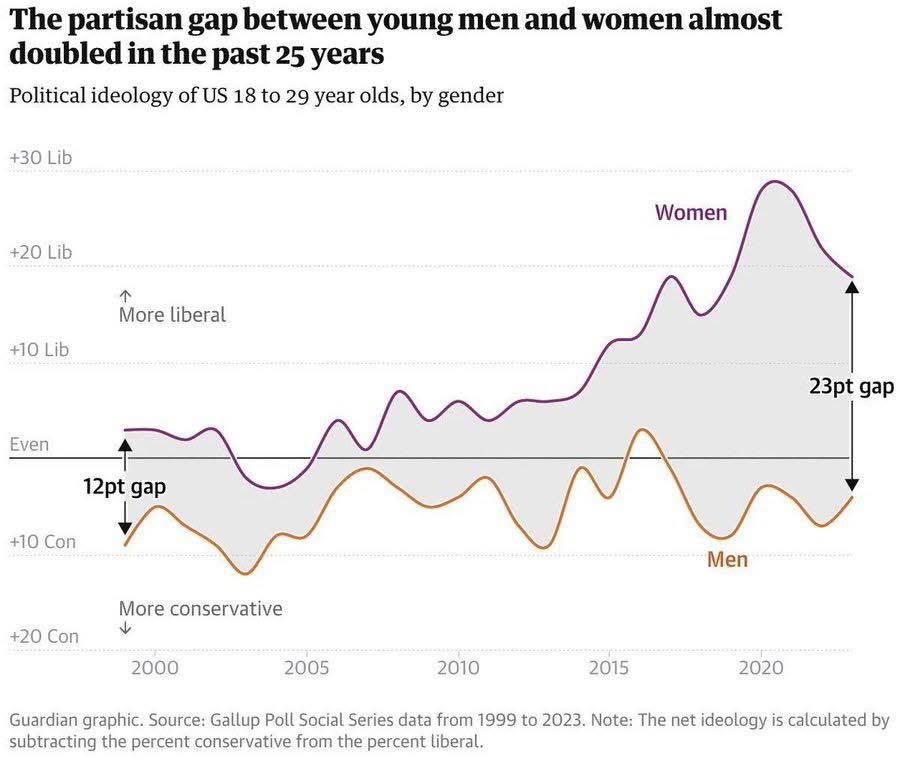
That shift is often described as progress. But the data alone cannot tell us whether a change is healthy or harmful. What it does tell us is that something powerful has been shaping beliefs across an entire generation.
Again Data shows that a much higher share of young women now identify as liberal compared to past decades, while young men remain closer to where they were. This gap has grown not just in the United States, but across much of the developed world. That matters because it tells us this is not simply about American politics or any one election cycle. Broader cultural and technological forces are at work.

And this pattern is not limited to the youngest generation. Women in their thirties through fifties also show a noticeable, though smaller, movement in the same direction. Many in this group were raised with more traditional or conservative values, and still consider themselves conservative, but they were also among the first adults to adopt smartphones and social media as everyday tools. The leftward shift in the Overton Window is not abrupt. It shows up as a gradual change over time, especially on issues shaped by culture, education, and family policy.
People do not form their views in a vacuum. Over the last twenty years, the way information reaches us has changed completely. Social media delivers a constant stream of signals about what is acceptable, what is rewarded, and what carries a social cost. These platforms are designed to maximize engagement, not understanding, and they tend to subliminally reward emotional reactions more than careful thought.
People also respond differently to constant social pressure. Some feel the weight of public approval and disapproval more strongly, especially when it is immediate and visible. That does not reflect weakness or fault. It reflects normal human behavior interacting with powerful technology that did not exist a generation ago.
The timing is hard to ignore. The sharpest changes in political identity line up closely with the rise of smartphones and the always-on social media starting around 2007. That same period saw rising anxiety and stress, particularly among young people. Traits that once helped people fit into small communities became far more intense when amplified online and reinforced day after day.

Institutions did little to slow this down. Universities, media, and professional spaces narrowed the range of acceptable viewpoints even as they shifted them to the left. Many conservatives learned quickly that certain opinions came with social or professional consequences. In that environment, going along often felt safer than speaking up. Over time, conformity became the default and the window shifts again.
Men and women often moved through different environments as they entered adulthood. Many men went into work where results matter more than agreement, such as trades, construction, engineering, resource development, or military service. In those fields, disagreement is normal and sometimes necessary. This is not a sexist statement or position, it is the reality of the data. Many women entered professions where consensus, messaging, and institutional norms play a larger role. These are differences in environment, not character, which have shaped experiences and outlooks.
Family changes added another layer. Marriage rates fell, and family life was delayed or discouraged. That shift affected how people viewed responsibility, government, and community. When family stability weakens, politics often steps in to fill the space. This helps explain why debates over education, spending, and government involvement have grown sharper, even among people who broadly share conservative values.
None of this means one group is right and another is wrong. It means systems changed faster than people were prepared for, and those systems pushed different groups in different directions and seemed to add clear dividing lines.
This divisiveness is not healthy for our state or our country. A society that turns disagreement into hostility and divides men and women into opposing camps cannot hold together for long. In Alaska, where independence and practical results define us, we see these pressures show up in debates over budgets, education, climate change, and resource development. Cultural and technological forces do not stop at the state line.
If we want to expand the Overton Window, or even shift it to the right, the solution is not to lecture people or pit groups against each other. It is to strengthen what grounds us. Strong families matter. Education should teach kids how to think, not what to think, and parents should have a real voice. Work that builds things and serves communities should be respected and supported. Technology companies should not be allowed to shape culture without accountability. Most importantly, we need room for honest disagreement without labeling it as hate.
Alaska has always done better when we focus on practical solutions, personal responsibility, and mutual respect. Energy development, responsible resource use, fiscal restraint, and individual freedom are not political slogans here. They are part of daily life.
This conversation is not about blame. It is about recognizing how powerful systems have changed our culture and deciding whether we are willing to push back and find common ground again. If we want a healthier future for the next generation, we need to be honest about what is happening and serious about fixing it.
Originally published on Substack: https://kevinjmccabe.substack.com/p/the-neo-political-gender-gap-is-growing