

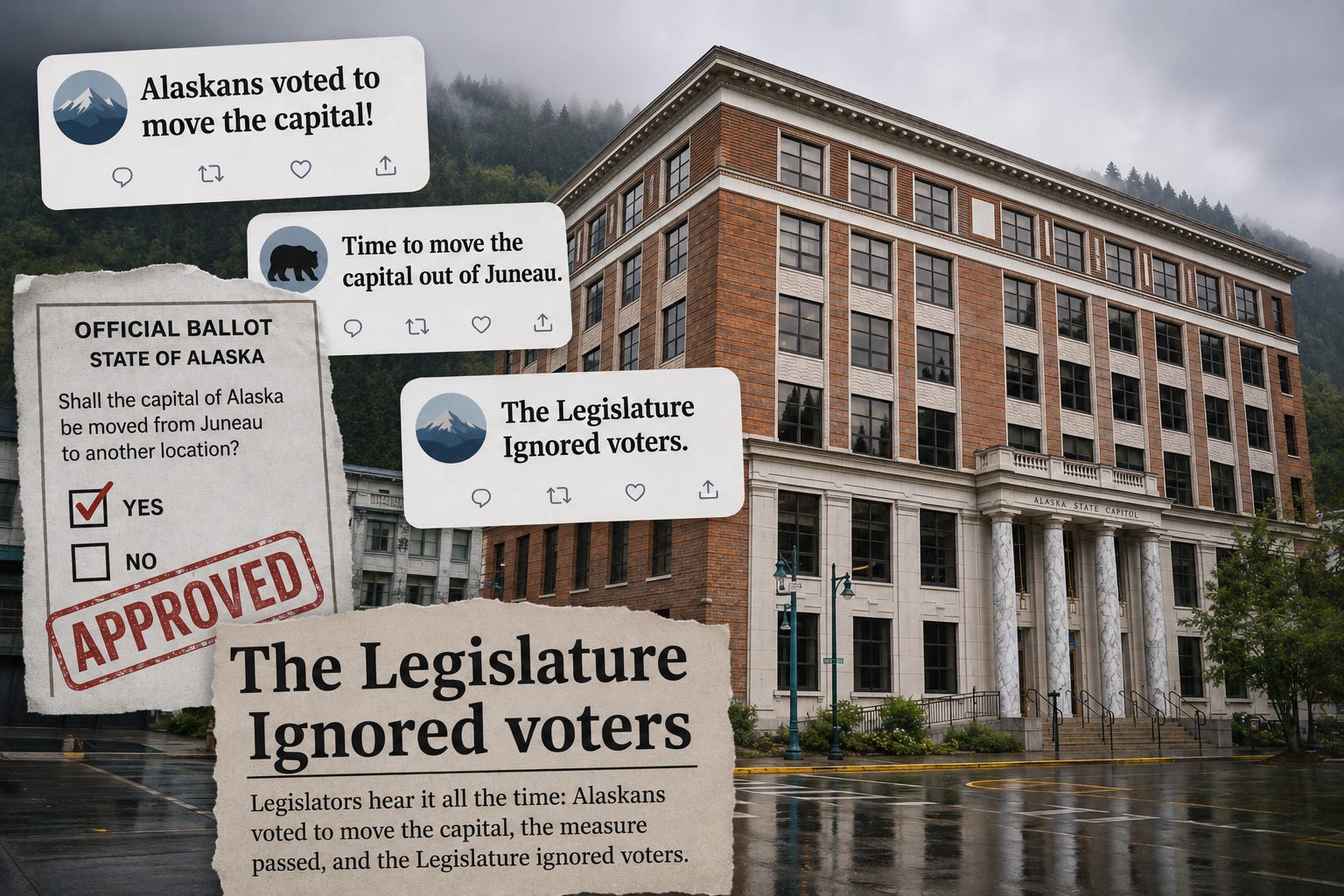
There is a constant drumbeat, in some social media posts, to move the capital out of Juneau. Legislators hear it all the time: Alaskans voted to move the capital, the measure passed, and the Legislature ignored them.
That is not what really happened.
Since statehood in 1959, voters have considered at least nine ballot measures to relocate the capital which is more than any other state. At times, they approved studying a move. In 1974, they approved relocating the capital in principle. In 1976, they selected Willow as a site. Yet on that same ballot, voters passed the FRANK Initiative, Fiscally Responsible Alaskans Needing Knowledge. FRANK requires full disclosure of all direct and indirect costs and voter approval of bonds before any relocation money can be spent. That voter-approved safeguard has been decisive in every move-the-capital discussion.
Every time voters were asked to approve the funding required to make a move happen, they said no. No relocation bond has ever passed.
Juneau’s role as capital predates statehood. After the United States purchased Alaska from Russia in 1867, Sitka served as the territorial seat of government. In 1900, Congress directed that the capital move to Juneau, and by 1906 the relocation was complete. When Alaska became a state in 1959, Juneau had been the capital for half a century, and it remained the capital under the new constitution.
As Anchorage and Fairbanks grew, frustration with Juneau’s location increased. The capital is accessible only by air or water, which makes travel expensive and time-consuming. As the centers of population and economic activity shifted north, debate about the location was inevitable.
The first two post-statehood relocation attempts, in 1960 and 1962, failed.
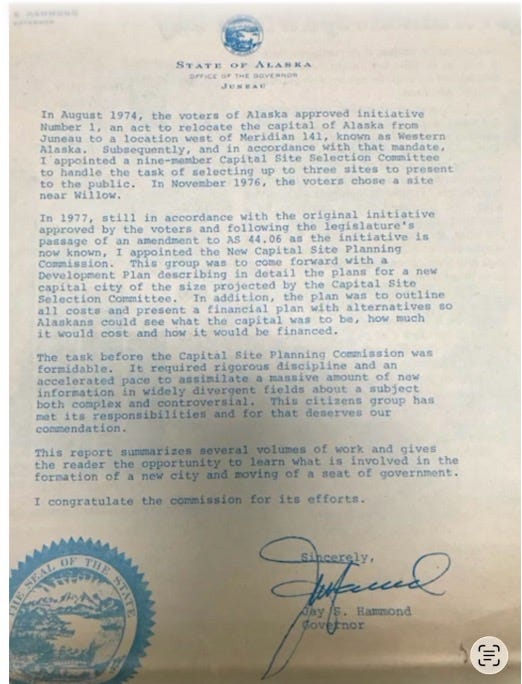
In 1974, during the oil boom, voters approved, in principle, moving the capital to Western Alaska. Two years later, they selected Willow. After Willow was chosen, Governor Jay Hammond followed through. A commission was appointed. Plans were developed. Infrastructure needs were identified. Costs were calculated. The state did exactly what voters directed.
Then voters saw the price tag.
In 1978, a bond to fund nearly one billion dollars for Willow failed overwhelmingly. In 1982, when projected costs rose to approximately $2.8 billion, voters were asked again. That measure failed. The no vote also repealed prior relocation laws and effectively ended the Willow plan. The concept had support; the funding did not.
In 1994, voters rejected a proposal to declare Wasilla the capital. On the same ballot, they overwhelmingly reaffirmed FRANK’s cost disclosure and bond requirements.
Then in 2002, voters considered Ballot Measure 2, formally titled the Initiative Petition Moving the Location of Legislative Sessions. It would have required legislative sessions to be held in the Matanuska-Susitna Borough, or in Anchorage if facilities were not yet available in the Mat-Su. Voters rejected it decisively, 153,127 no to 74,650 yes, a margin of more than two to one.
The pattern is clear. Alaskans have been willing to explore relocation. They have not been willing to authorize the bonds necessary to pay for it.
Even in recent years, the conversation has taken on new language in some circles. Beyond traditional arguments about access and cost, some advocates now frame relocation in terms of “decolonization” and the symbolic role of Juneau as the seat of government. We recently addressed that historical argument in greater depth in a separate essay which you can read here. The motivations behind calls to move the capital may evolve, and they do not come solely from one political perspective, but the fiscal consequences remain the same.
As co-sponsors in the 34th Legislature of House Bill 3, which would allow regular and special legislative sessions to convene in Anchorage, we support any effort to improve accessibility to lawmakers for Alaskans. HB3 bill reflects ongoing concerns about travel, attendance, and public access, yet it still faces the familiar fiscal hurdles of significant costs.
While official legislative sessions continue to meet in Juneau, some off-site hearings or meetings have been held in Anchorage. Attendance at these events is varied, highlighting a practical reality: moving sessions closer to the population center does not automatically guarantee robust public participation.
Relocation is not simply moving desks. It requires housing, utilities, digital infrastructure, meeting space, hotels, restaurants, and long-term operating commitments. The Legislature employs hundreds, from lawyers to finance staff, all requiring housing or hotels. And the fact that Juneau provides economic stability to Southeast Alaska cannot be ignored. Many Alaskans are also cautious about concentrating political power in the larger cities. These are serious financial and policy considerations.
Despite this long history, we remain committed to finding practical ways to increase public access to government. Through legislation, technology, outreach, and, where appropriate, travel assistance, we will continue working to ensure Alaskans can engage with lawmakers, participate in hearings, and be heard.
Almost since statehood, Alaskans have examined the question of relocation. Yet each time the full financial commitment was placed before them, they declined to fund it. That record is clear. The capital has not remained in Juneau because legislators ignored the voters. It has remained because voters refused to approve the bonds required to move it.
Future arguments may be framed in new ways, whether around cost, access, or decolonization. If voters choose to authorize the funding necessary for relocation, that decision will be respected by the legislature. Until that happens, the constitutional capital remains in Juneau, and our obligation is to make Alaska’s government as accessible, transparent, and accountable as possible for every citizen, in every region of this state.
Note. This Column by Rep. Garret Nelson & Rep. Kevin McCabe was originally published in the Alaska Story. I have reproduced it here merely for posterity.