


A letter showed up at my house in Big Lake not long ago. Campaign letterhead. A few paragraphs thanking me for an ADN op-ed I wrote supporting Senator Dan Sullivan.
Nothing unusual about that. Campaigns send thank-you letters all the time.
But at the bottom, below the typed “Best,” Dan signed his name. Then, in blue ink across the page, he added four words:
“Thanks again, Kevin!”
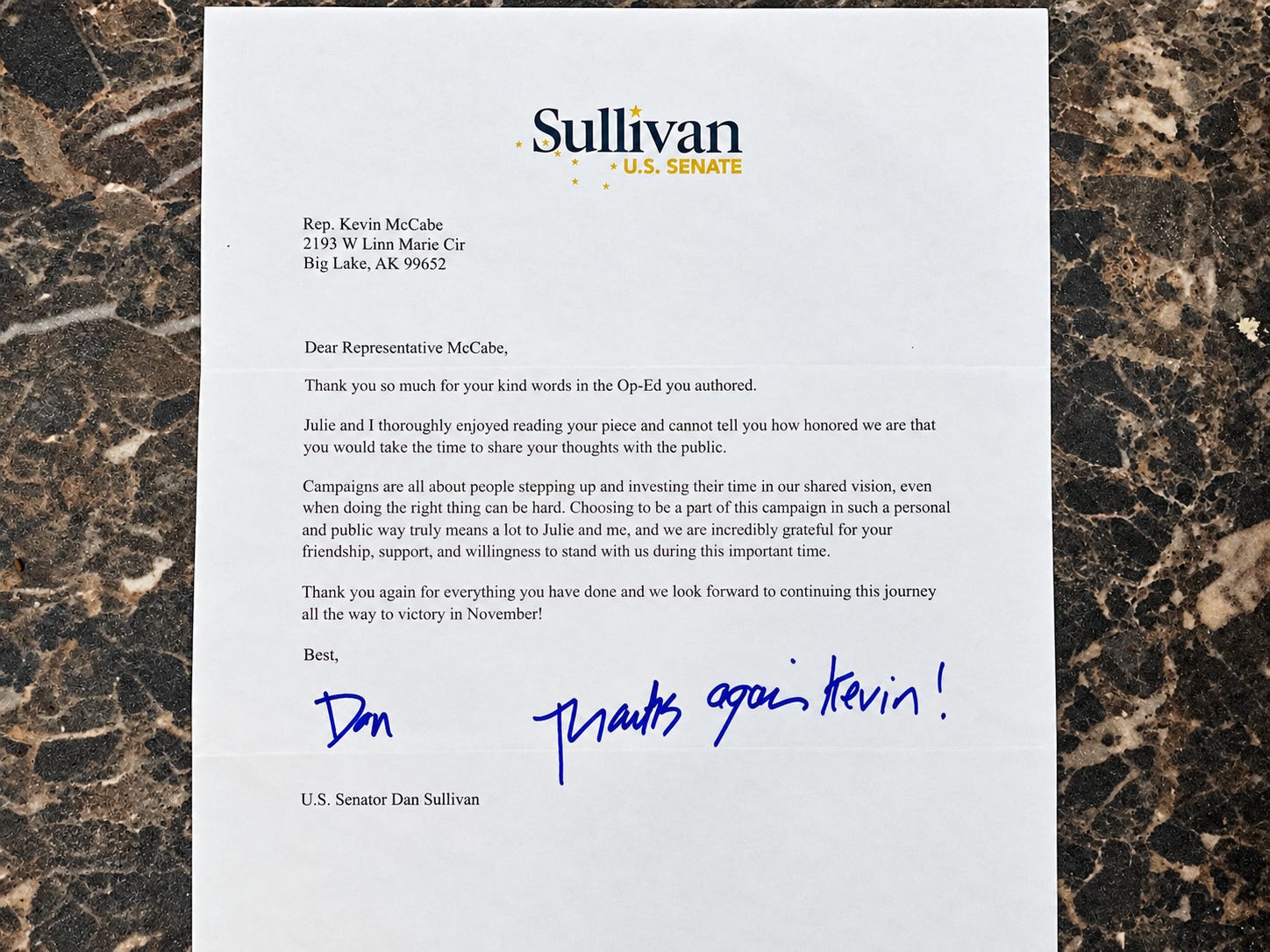
It was a small thing, and that is exactly why it mattered.
My op-ed had already run. Whatever benefit it gave his campaign was already in the bank. The letter wasn’t going to move a poll, raise money, or make a headline. And a state representative from District 30 isn’t going to move the needle in a U.S. Senate race.
Dan had nothing to gain by taking another 30 seconds to write those four words.
I write a lot on my Substack about leadership and trust. Those aren’t concepts I learned in politics. I learned them during 20 years in the Coast Guard and later on the flight deck of a 747. A crew either trusts the person in charge or it doesn’t, and you don’t build that trust during an emergency. You build it beforehand, in the small decisions and in how you treat people when nobody is keeping score. You build it the way Marines do, in the everyday way you treat people.
High office can make it easy to see people for what they can do for you. Staff, donors, consultants, reporters, other politicians. Taking the time to personally thank somebody who can’t do much more for you tells me something about a man.
Which brings me to Mary Peltola.
On September 23, the New York Times published an account based on interviews with nine former staffers, along with text messages and photographs the paper reviewed. Those aides described angry and profane outbursts, slurs, and one incident in which an aide said Peltola shoved them. The Times also reported on a disturbing 2024 text involving a Planned Parenthood board member. Her congressional office had unusually high staff turnover, according to LegiStorm, and just before the August primary shep replaced her longtime campaign manager and other senior staff.
Her campaign disputes several allegations and has acknowledged and expressed regret for one of the slurs. It has also pointed to the deaths of her husband and mother in 2023. That grief is real, palpable, and I would not wish it on anyone.
While grief can explain a hard season, it doesn’t answer questions about a pattern of conduct described by multiple former employees. There is an old saying that people don’t usually leave jobs, they leave bosses. When people keep walking out the door, eventually you have to stop blaming the door.
We need a leader in the Senate, someone who can build a team, not excuses.
I have written before that when trust is damaged, there is only one real way to start repairing it: own it. No excuses, no consultant-written statement, and no hiding behind a spokesman. Every Marine I’ve known would just own it. So far, Alaskans have mostly gotten campaign statements and a candidate walking away from reporters asking questions.
That isn’t ownership. It’s damage control.
We don’t get to see everything a U.S. senator does. We don’t see how they treat the young Alaskan staffer working late, the scheduler who makes a mistake, or the constituent calling for the third time because the VA still hasn’t fixed his claim. We get glimpses.
A newspaper investigation is one glimpse. A handwritten note is another.
I’m keeping Dan’s letter because it reminded me of something I learned long before politics: character shows up when there is nothing to gain.
When you fill out your ballot in November, ask yourself a simple question: How does this person treat the people who can’t do anything for them?
Dan Sullivan answered that question in blue ink.
Semper Fi, Senator. I’m proud to call you my senator.