

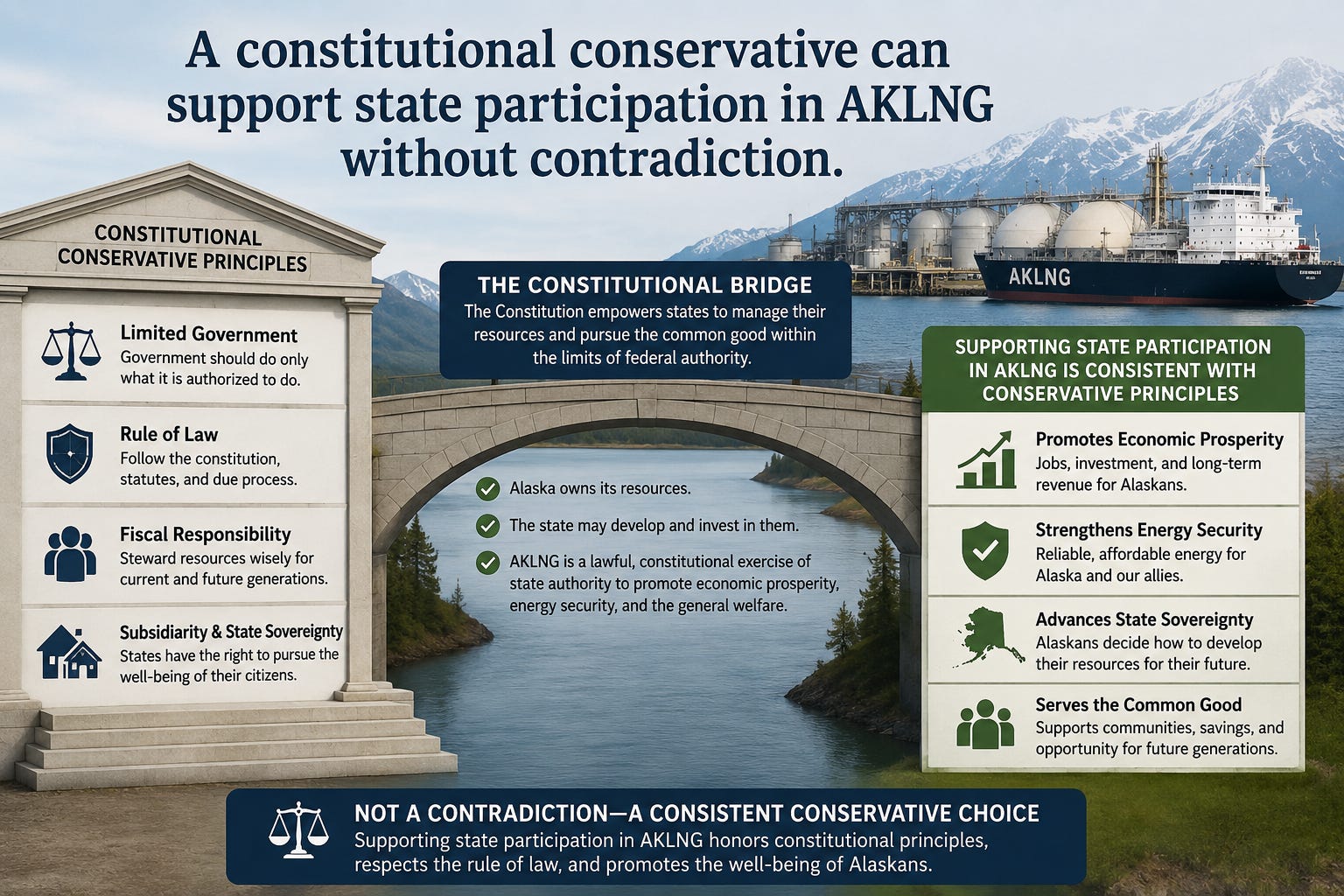
I got a fair question after my Gaslighting the Gasline essay last weekend. If you call yourself a small-government conservative, how do you justify any state role in a project like AKLNG? Isn’t that just picking winners and calling it principle?
No, it isn’t. But you have to start by clearing up a confusion that has crept into our own ranks. Small-government conservatism is not libertarianism. They overlap, but they are not the same thing. The conservative tradition in this country has never said government has no role. It has said government has a defined role, a limited role, and a responsibility to act within that lane with discipline and accountability.

That distinction matters in Alaska more than almost anywhere else, because here the role is not just philosophical, it is written down. Article VIII, Section 2 of our constitution is not a suggestion. It is a directive. The Legislature shall provide for the utilization, development, and conservation of all natural resources belonging to the State, including land and waters, for the maximum benefit of its people. That is a duty. It was put there by Alaskans who had seen what happens when outside interests control the resource and locals get scraps.
The framers were not ideologues. They were practical and focused on Alaska. They understood two things at the same time. First, unchecked federal control treated Alaska like a colony (it still does by the way). Second, purely private extraction without structure did not guarantee Alaskans would benefit. So they placed the responsibility squarely on the state, and more specifically on the Legislature, to act as a trustee. The courts have reinforced that. Yet the legislature has largely failed in that effort. The resource is held in trust, the people are the beneficiaries, and the Legislature is responsible for making sure the outcome reflects that relationship.
That has consequences. A trustee does not get to sit on his hands and call it principle. A trustee does not watch a resource sit stranded for decades while the beneficiaries pay some of the highest energy costs in the country. And a trustee does not hide behind slogans about free enterprise to avoid doing the hard work of structuring a deal that actually serves the public, even if they don’t like the executive.
That is where the AKLNG debate needs to land. The state’s participation, including AGDC’s equity position, is not some ideological betrayal. It is the state stepping into its constitutional role. You can argue about the terms. You should argue about the terms. The work happening right now on HB 381, SB 280, and SB 275 is exactly the kind of debate that needs to happen. Tax structure, in-state pricing, audit provisions, transparency, all of that needs to be negotiated hard and in the open. But the idea that the state has no business being at the table does not square with the document we swore to uphold.
Critics will say that once you open that door, anything can be justified. That is not true if you apply the test conservatives have always applied. Does the action crowd out private enterprise, or does it enable it where it would not otherwise exist? Is it tied to a legitimate public interest? Is it proportionate? Does it protect the public’s share of the benefit, or transfer it away?
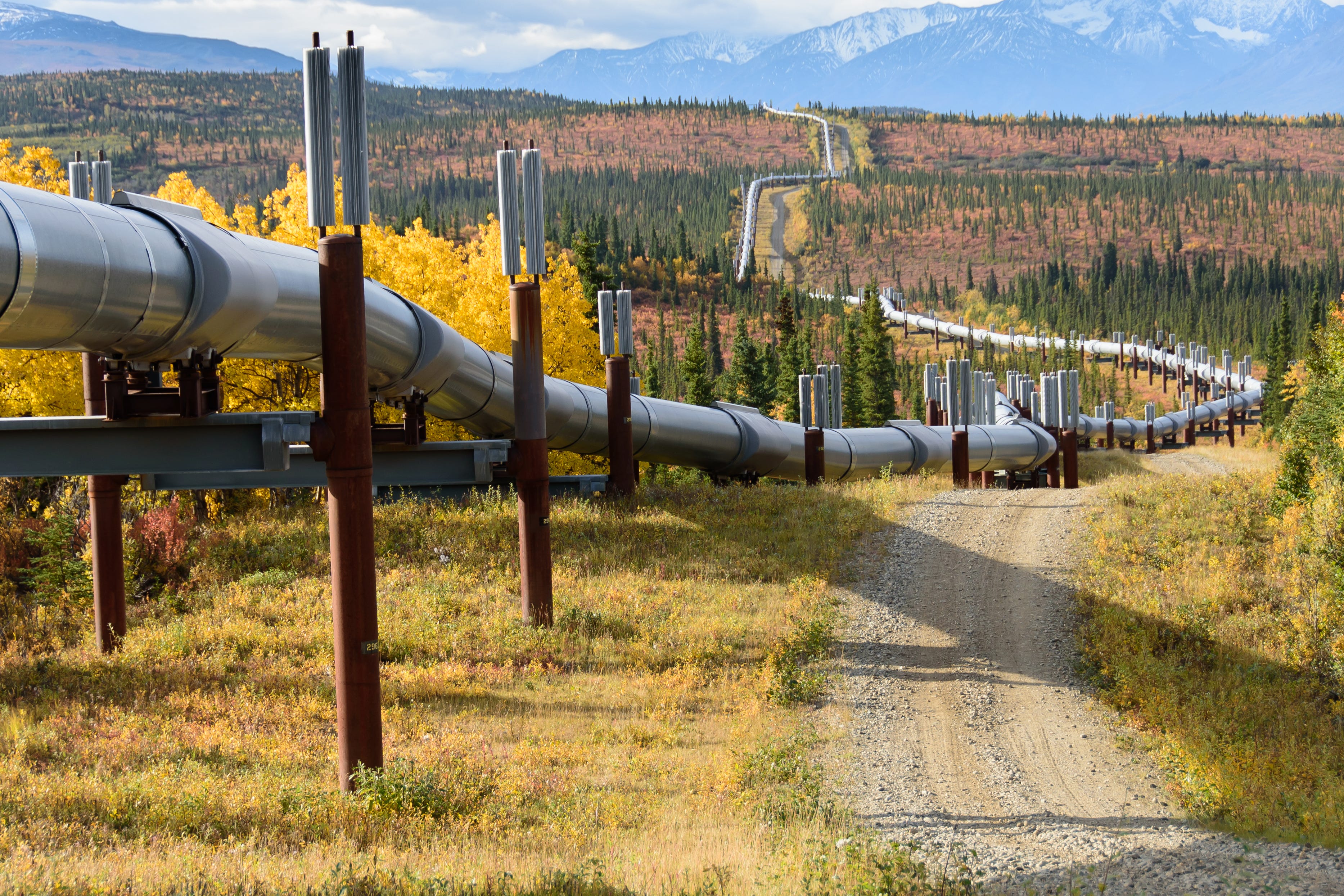
We have answered those questions before. The Trans-Alaska Pipeline did not happen on a handshake between private companies. It required federal action, right-of-way authority, and a framework that made the project possible. Conservatives supported it because the payoff was clear and generational. The same is true of the interstate highway system, rural electrification, and other foundational projects. They were not seen as socialism. They were seen as necessary.
AKLNG sits in that same category. The state owns the gas. The constitutional duty is explicit. The strategic case is not theoretical, it is right in front of us as global energy demand shifts and Alaska sits on a resource it has failed to monetize for sixty years. Private capital has had every opportunity to solve this on its own and has not done it. That is not a criticism, it is a reality of scale, geography, and risk.
So the question is not whether the state should be involved. The question is whether the state will do its job well. Will we negotiate from a position of strength? Will we insist on terms that protect Alaskans? Will we structure this in a way that delivers long-term value instead of short-term headlines? Or will let an opportunity to be great slip from our fingers.
A conservative who supports state participation here is not abandoning principle. He is applying it in full. Limited government does not mean absent government. It means government that stays in its lane, acts when it is supposed to act, and answers to the people when it does.
The libertarian argument against any state role is worth hearing. It sharpens the debate. But it needs to be called what it is. It is a libertarian argument. It is not the one our constitution lays out, and it is not the one Alaska was built on.
We can disagree on execution. We should. That is the Legislature doing its work. But we should not pretend the responsibility itself is optional. It is not. The framers settled that question a long time ago.
Federal support is waning while we squabble. Time to put the extraneous crap aside and build a pipeline.