

Ballot Measure 1 says it only caps what individuals can give a candidate at $2,000.
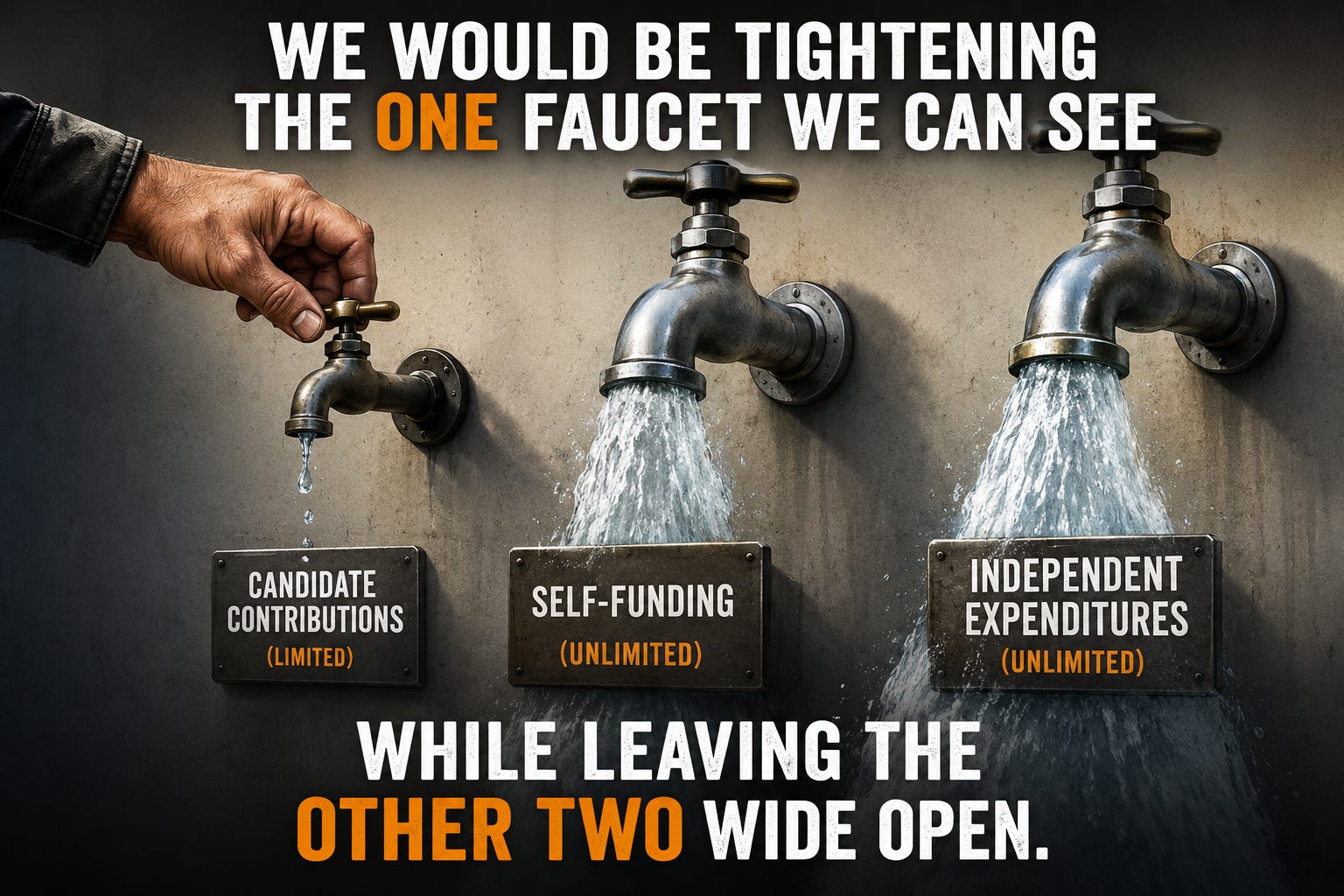
It does not cap what a wealthy candidate can spend on himself. The Supreme Court settled that years ago. It does not cap what an outside group can spend independently. That is another court case called Citizens United.
So if Measure 1 passes, does the money leave Alaska politics?
No. It moves.
It moves out of the candidate’s account, where you can see it and hold someone accountable for it, and into places where you cannot.
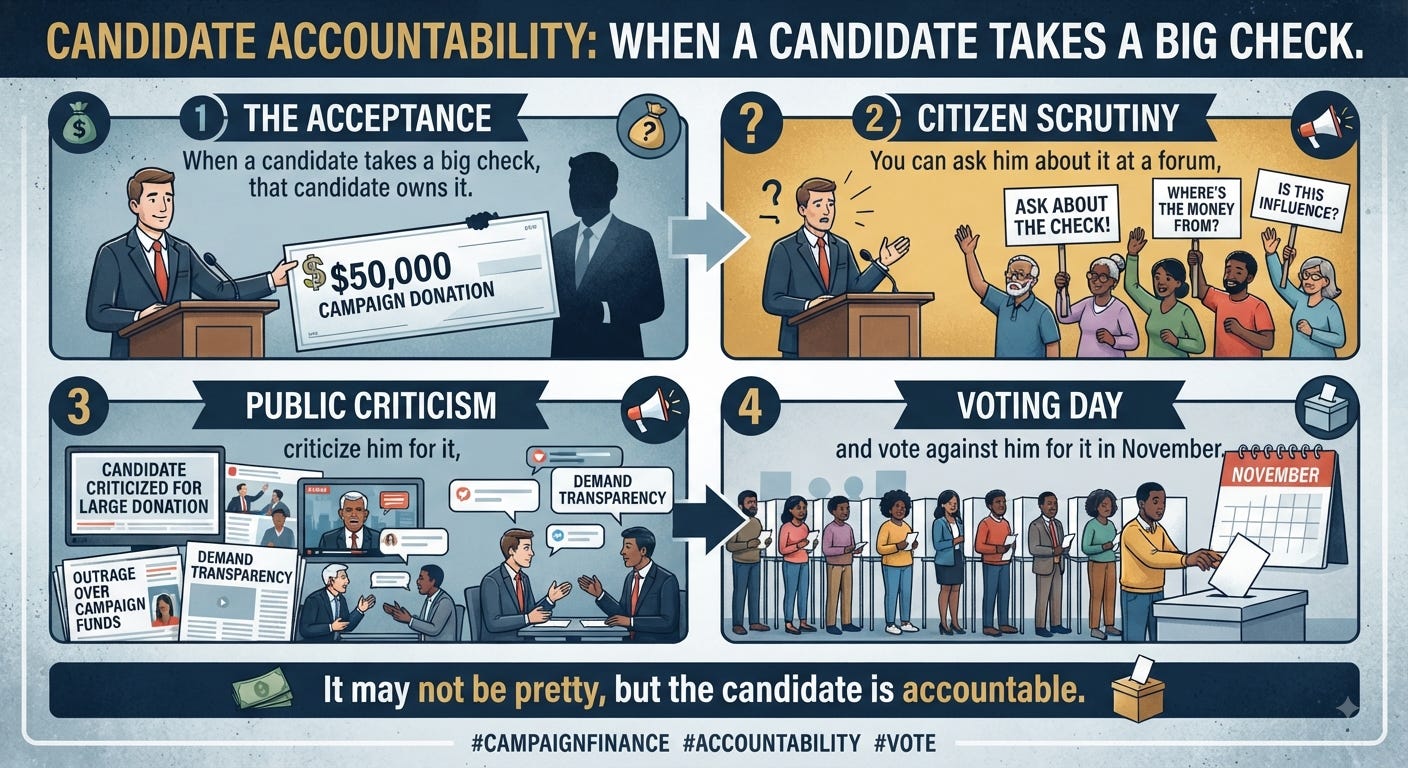
When a candidate takes a big check, that candidate owns it. You can ask him about it at a forum, criticize him for it, and vote against him for it in November. It may not be pretty, but the candidate is accountable.
Move that same money to an independent expenditure group and the candidate can tell you he has no control over it. And he is telling the truth.
Look at the current governor’s race. The Republican who has raised the most has put more than a million dollars of his own money into it. Another Republican is being supported by a large union-funded outside group. Measure 1 touches neither one. Not a dollar.
We would be tightening the one faucet we can see while leaving the other two wide open.
Plenty of that independent money comes from Outside, from people who do not live here, do not work here, and do not have to live with what they do to this state. Alaskans have complained about outside money for years, and rightly so. Measure 1 gives it more room, not less.
House Bill 16 was virtually the same as Ballot Measure 1, and when it reached the House floor last April I offered several amendments aimed at those loopholes. One would have capped what any person could give an independent expenditure group. Another would have put a line on the mailer and the television ad telling Alaskans that more than 30 percent of the money behind it came from outside this state. Every one of them was voted down by the same Majority Coalition that carried the bill, and the sponsor objected to each one because he wanted the bill to match the ballot measure word for word.
There is a reason for that. If the Legislature passes a law substantially the same as a pending ballot measure, the vote on that measure is canceled. Any change to the bill risked breaking that match.
I can’t tell you he was hiding anything. He had four separate chances to address the loopholes he says concern him, but he did choose to protect the vehicle instead of fix the problem. This is worrisome to me.
That’s not an oversight. It’s a choice. And I believe it was the wrong choice.
Measure 1 also changes how contributions are counted.
The old law counted by the year. Measure 1 counts by the election cycle, generally two years. Alaska’s cap on what a PAC can give a candidate was never struck down. Political parties are a separate category with much higher limits, but a PAC that is not a political party is still capped at $1,000 a year under AS 15.13.070. Over two years, that is $2,000.
Measure 1 makes it $4,000.
Same two years. Twice the money, in a measure being sold as restoring campaign finance limits. Weird, right?
Measure 1 allows $2,000 to a candidate per election cycle, but $5,000 to a group per year. Over the same two-year period, that means $2,000 to the candidate and $10,000 to the groups.
They used the election cycle when it capped you. They could not even find it when the money went to the groups.
Supporters argue that changing to an election cycle helps challengers because an incumbent can file early and collect money over two years while a challenger who enters later may have only one.
There might be some logic to that, but the larger disadvantage for a challenger is not the calendar. It is the ceiling.
An incumbent already has a donor list, name recognition, political relationships, and association networks. A challenger usually has none of those things. He needs somebody willing to back him early, before most voters even know his name.
Changing the calendar does not give him a donor list, name recognition, or an organization. It lets him hit the same ceiling on a different schedule while organized groups get to give more.
Individuals down. Organized groups up. And organized groups have their favorite incumbents.
Contribution caps are sold as a check on the powerful. But In practice, they can protect the people already holding the seats.

There is another problem. In 2021, the Ninth Circuit struck down three parts of Alaska’s campaign finance law, including the cap on what a candidate could accept from out-of-state donors. Measure 1’s own ballot title says it restores limits on out-of-state contributions.
Alaska spent years litigating that case. If this provision is challenged again, we could end up right back in federal court paying lawyers to defend it.
Strip everything else away and Measure 1 limits what you can give directly to a candidate. It does not limit what a wealthy candidate can spend on himself. It does not put the same cap on independent expenditure groups. It doubles what organized groups can give directly to a candidate. It allows $10,000 to flow into groups over the same two-year period in which you are capped at $2,000 to the candidate. And it takes Alaska back into an area where we have already lost in federal court.
Those are not side issues. That is the measure.
Your first amendment right to back a candidate you believe in is not the problem with Alaska politics. Huge super PACs and Outside dark money is.
Protect your First Amendment Rights. Vote no on Ballot Measure 1.