

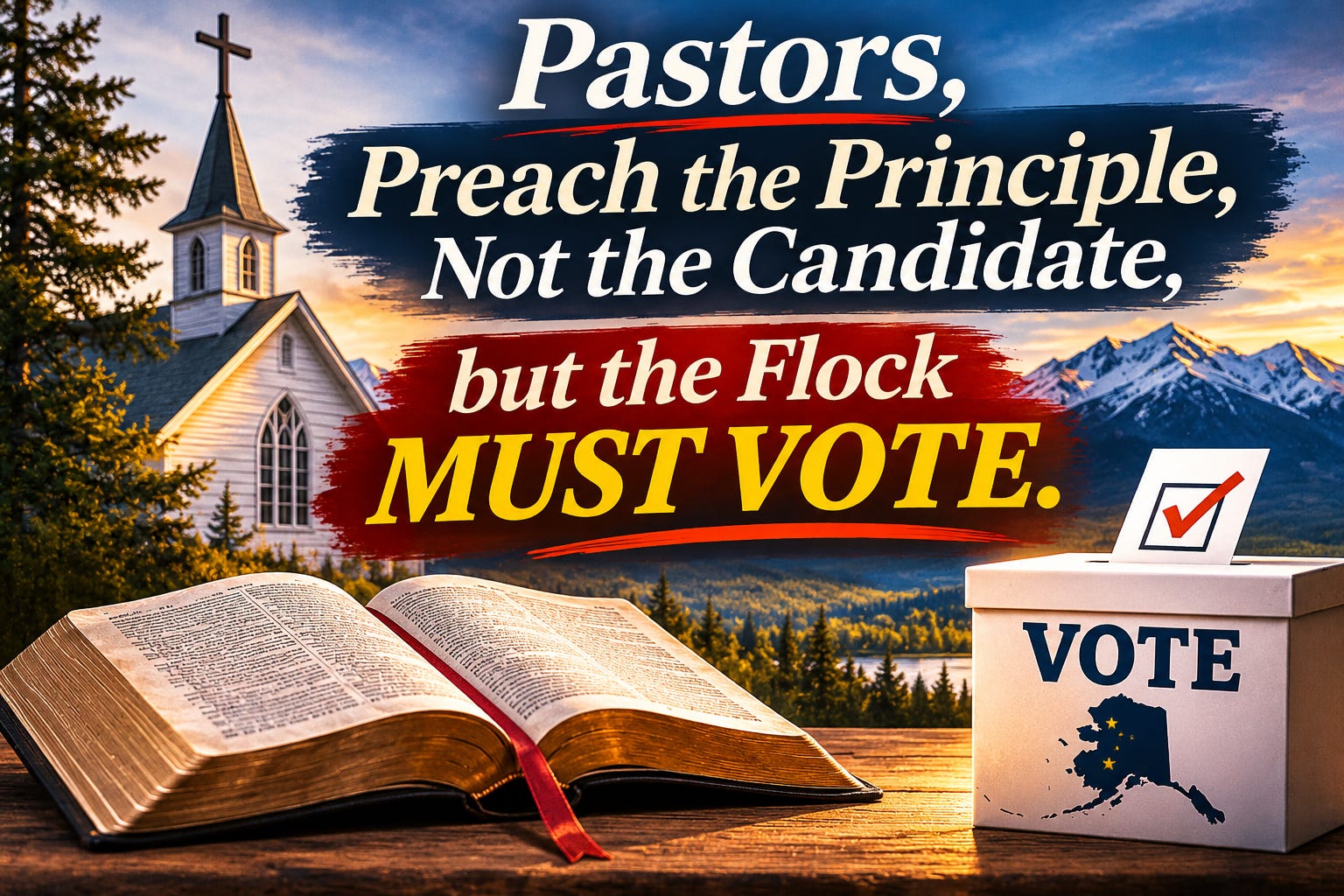
I’ve seen some criticism on social media lately of churches here in the Mat-Su Valley of Alaska that invited political candidates to Sunday services and prayed over them. Full disclosure: I was one of those candidates. Frankly, I don’t see the problem. Praying for those who seek public office is something Christians ought to do, whether they agree with the candidate or not. Inviting a candidate to worship and praying for him is not the same as endorsing him. We ought to know the difference.
You all know where I stand. Freedom of religion does not mean freedom from religion, and as John Adams said, our Constitution was made only for a moral and religious people.
This week, a friend sent me a short essay that raised a fair question. If the Bible is the ultimate truth for Christians, should pastors water it down to keep the IRS happy? With an election two days away, it’s worth talking about.
Start with what the law actually says. The Johnson Amendment became part of the federal tax code in 1954, pushed by then-Senator Lyndon Johnson after two organizations opposed his reelection. It prohibits tax-exempt organizations, including churches, from endorsing or opposing political candidates. It does not prohibit pastors from preaching about abortion, marriage, religious freedom, honesty in government, or caring for the poor. It never has.
In July 2025, the IRS told a federal court that a church endorsing a candidate to its own congregation was more like a family conversation than a political campaign. A federal judge later declined to approve that settlement, so the existing rule remains on the books. Still, pastors have far more freedom in the pulpit than many believe.
The more important question is this: just because a pastor can say something, should he?
Last year, I wrote about the Black Robed Regiment, the name the British gave the colonial preachers who helped lay the foundation for American independence. For more than a century, New England legislatures invited ministers to deliver election sermons. Governors and lawmakers sat in the pews while preachers reminded them that their authority came with responsibilities, and that they would answer to God for how they used it.
In 1750, Jonathan Mayhew preached that Christians were not bound to obey rulers who acted against the very purpose of government. James Caldwell, a Presbyterian minister in New Jersey, became a target of the British, and at the Battle of Springfield in 1780, the story goes, he gathered hymnals for musket wadding when the militia ran short. John Witherspoon, another Presbyterian minister, signed the Declaration of Independence.
These weren’t timid men. They spoke biblical truth to power. They challenged kings and called out governments that had gone too far. But they didn’t really tell their congregations which leader to support. They preached liberty, justice, the limits of government, and the rights God gave mankind. They measured rulers against those principles and trusted the people in the pews to understand the difference.
They preached the principle, not the candidate.
A pastor today doesn’t need to tell his congregation who to vote for. He can preach what Scripture says about life, marriage, honesty, justice, and the duty of government to protect the God-given rights of its citizens. Then he can let the congregation compare those teachings with what the candidates believe and how they have voted.
Some people worry that inviting candidates into church turns worship into a campaign rally. Others worry that a pastor who endorses a politician ties the church’s reputation to a flawed human being. Those are fair concerns. Politicians are imperfect people. I ought to know. I’m one of them.
But the answer isn’t to keep quiet about what the Bible teaches.
A pastor should be able to say that taking an innocent life is wrong. He should be able to speak against the government shutting down churches while other businesses stay open. He should preach about honest dealings, caring for widows and orphans, and the duty of those in authority to serve the people rather than rule over them.
If those teachings make a politician uncomfortable, perhaps the politician ought to examine his own positions instead of expecting the pastor to change his sermon. That’s not politics invading the church. That’s the church doing what it has always been called to do.
Here in Alaska, we should understand that better than most. Our state Constitution begins by acknowledging our gratitude to God and to those who founded our nation and pioneered this great land. From the Russian Orthodox churches of Kodiak and Sitka to the small congregations across the Mat-Su Valley, churches are where we gather, worship, mourn, celebrate, and help our neighbors when times get tough.
In many of our communities, a pastor’s words carry more weight than anything a politician might say. So yes, that’s exactly why those words must be spent on biblical truth, not political endorsements.
So to the churches that invited candidates and prayed for them, I say good for them. Scripture tells us to pray for those in authority. I think we ought to pray for those seeking that authority, too, regardless of party. Lord knows we need it. I need it. But praying for a candidate is different from telling the congregation to vote for him, and that distinction matters.
Pastors, the pulpit is yours. Preach the whole counsel of God, including the parts that make Washington and Juneau uncomfortable. Don’t water it down for the IRS, a political party, or anyone else.
Preach the principle. Trust the flock.
And on Tuesday, let’s all vote like it matters. Because it does.