

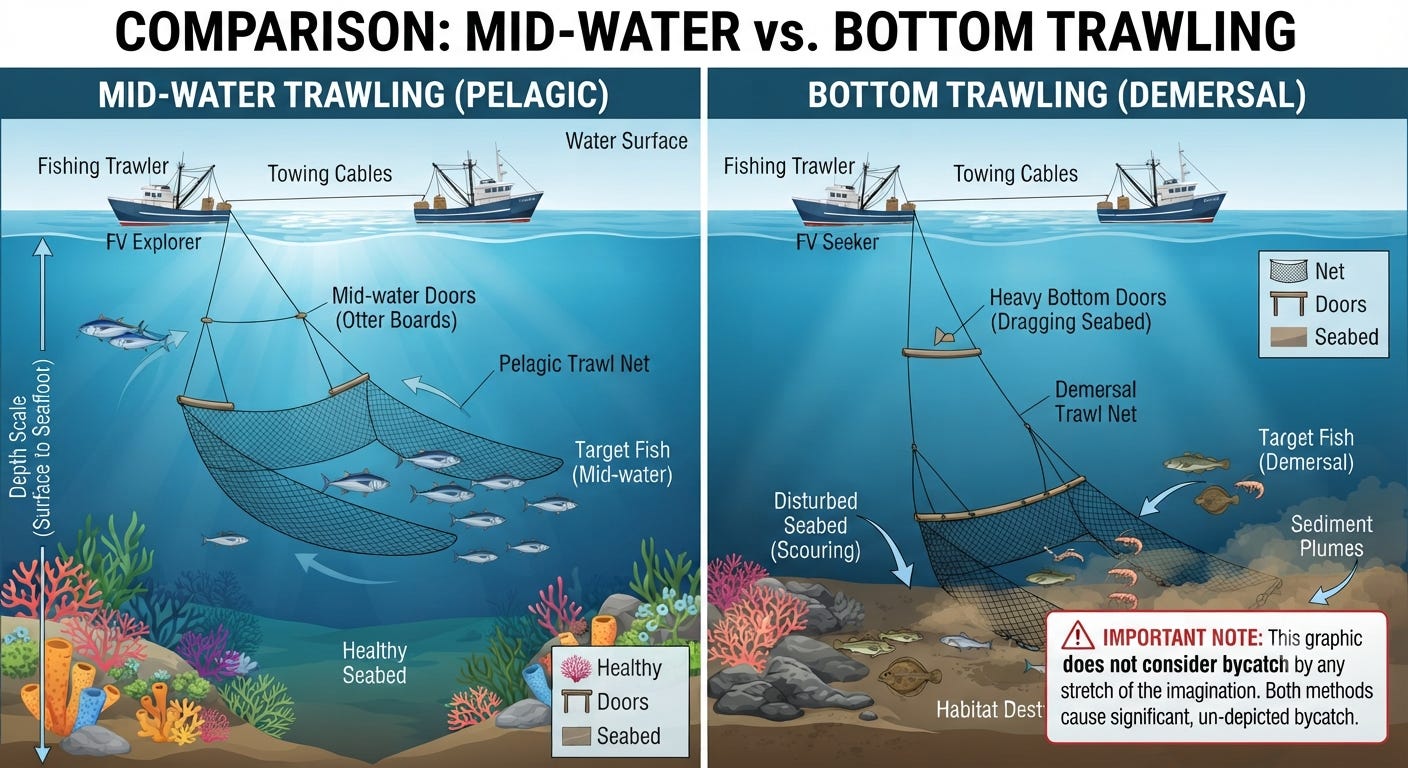
One of the more thoughtful and authentic responses to my recent column came from someone who is, or was, in the pollock fleet. I appreciate that. It brought firsthand knowledge into a conversation that too often gets reduced to slogans, memes, and bumper stickers. And it made an important point: not every trawl fishery is the same. That distinction matters, and anyone who wants an honest discussion ought to acknowledge it.
But once we agree that distinctions matter, we have to follow the facts wherever they lead.
The distinction that ultimately matters isn’t pollock versus cod. It isn’t the Gulf of Alaska versus the Bering Sea. It isn’t catcher boats versus factory vessels.
No, the defining question is much simpler: does the gear contact the bottom?
That’s where the seafloor is disturbed, where the sediment structure and the animals living in it are damaged, and where long-lived corals and sponges, in the places they exist, are lost. That’s where the conversation should remain focused.
The obvious example is dedicated bottom trawling, where contact with the seafloor is part of the fishing method. The more difficult question is the fishery that describes itself as pelagic or midwater. The defense has always been that because the target species is suspended in the water column, the gear stays off the bottom.
The problem is that the science doesn’t support treating that as an absolute.
A National Marine Fisheries Service analysis found that pelagic trawl gear operating in the Gulf of Alaska and the Bering Sea contacted the seafloor across anywhere from 40 to 100 percent of the width of the net during fishing operations, often while towing for miles. Other analyses presented to the North Pacific Fishery Management Council reported average bottom contact between 40 and 80 percent of fishing time, with some factory vessels approaching continuous contact. Those findings are precisely why the Council continues to examine gear modifications and performance standards intended to reduce bottom contact.
In other words, “midwater” does not necessarily mean the gear remains off the bottom. It means that sometimes it does, and sometimes it doesn’t.
That isn’t an indictment of the men and women who fish these vessels. Quite the opposite.
Every experienced trawl captain knows when the gear is beginning to touch bottom. Modern vessels have sonar, net sensors, sounders, and decades of accumulated experience. They know what they’re seeing. More importantly, they know how to adjust. They can change depth, alter the tow, modify the gear, or move to different water. No regulator sitting in Juneau or Washington can make those decisions nearly as effectively as the people on the back deck and in the wheelhouse.
That is where I believe the conversation belongs.
This isn’t about saying every trawl fishery is the same, because they aren’t. Nor is it about pretending that every vessel operates without affecting the seafloor, because the available evidence says otherwise. It’s about recognizing that bottom contact is the hidden issue, perhaps the real and most important issue, because the seafloor is the environment where the resource lives. It’s about understanding that even pelagic gear can and does contact the bottom and finding ways to reduce that contact wherever possible.
I suppose it could be a request. I would hate to think it would be regulatory.
So, if the industry chooses to lead that effort, it will find many Alaskans willing to stand alongside them.
Because I don’t believe anyone should welcome the other path(s) to a solution. Public patience is wearing thin. If the fishing industry refuses to draw the line at the bottom, the public eventually will. And when that happens, the debate will no longer be about improving gear or reducing contact. It will be about eliminating the practice altogether.
It would be far better for everyone if we solve the problem while the solution is still simply this: keep the gear off the bottom.