

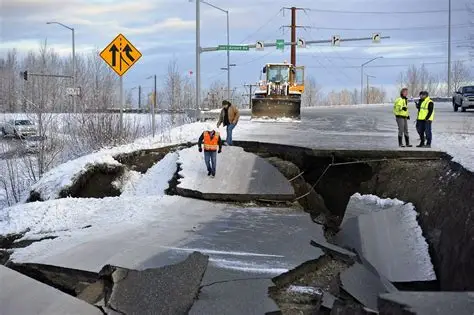
Imagine driving on a road full of potholes in the middle of winter or waiting months for a bridge repair that could make your commute safer. Imagine a gold or critical minerals mine unable to get its product to market, or a pipeline construction project delayed because materials cannot be shipped. Imagine a State Trooper not able to get up the Parks Highway to an accident due to the roads. These are not hypothetical problems. They are real, immediate, and the result of an imminent budget issue the Alaska legislature must address. Right now, in January 2026, the legislature is discussing a supplemental budget that includes $70 million to match federal transportation funds. This is not just political talk. It affects contractors, jobs, roads, and the economy that everyday Alaskans depend on.
Alaska’s transportation system, including highways, bridges, airports, and ports, relies heavily on federal funding. Programs like the Federal-Aid Highway Program send hundreds of millions of dollars to states each year. Alaska receives roughly $600 to $700 million annually for projects that keep communities connected, support commerce and resource development, and keep people safe via the Federal Infrastructure lifeline that connects our country.
But there is a catch.
To access that federal money, the state must provide a match, usually about 10 percent. That is what the $70 million covers. Without it, Alaska loses access to these funds. Projects get delayed or canceled. Roads crumble. Bridges age. Every state participates in this Federal Highway funding system because it works. For every dollar Alaska spends, we get nine or ten back in federal funding. That translates into jobs, stronger local businesses, and tax revenue for schools, healthcare, and public services. In Alaska, where private markets cannot build roads to every village, this partnership is not optional. It is necessary. Keep in mind that we pay into those federal dollars with gas and tire excise taxes. Should we now tell the feds we do not want them to return the dollars to us.

Industry groups, including the Associated General Contractors of Alaska, warn that without this funding, the 2026 construction season could stall, and I agree. It could. Unlike other states, Alaska’s summer window for building is short, and delays could wipe out opportunities, while putting contractors who have already hired crews and bought materials, in serious financial jeopardy. The result could be bankruptcies, thousands of jobs lost, and workers leaving the state. The economic ripple could exceed $1 billion, affecting suppliers, restaurants, and families across Alaska. Let’s not do that.
Some people say that contractors who rely on federal funding have weak business models and should fail if the money disappears. But that argument misses the point. These firms compete for projects that must be done for public safety and for the economy. Losing federal funds does not weed out weak companies. It takes work away from solid operators. It is like telling a fisherman the ocean is off limits mid-season, not because of overfishing but because of paperwork. Every delayed road, bridge, or airport project puts families, tourists, and local businesses at risk.

The supplemental budget funding will likely require using the Constitutional Budget Reserve, which takes a three-quarters vote in both chambers. More than 20 groups, including businesses and unions, are calling for the $70 million to be paid sooner rather than later, emphasizing the risk to jobs and the economy if contractors cannot plan for the upcoming season. And in the crucible of Juneau, lawmakers use this kind of pressure to negotiate broader deals. CBR votes can be tied to Permanent Fund Dividend decisions, education funding, or other budget or district priorities such as trooper posts or other road work. Minority members may resist large CBR draws, since their votes are required, but the threat of economic harm increases the likelihood of action.
Therein lies the political leverage.
This debate is not about bailing out contractors or the federal strings attached to the money. It is about investing in Alaska’s future, in America’s future. Roads and bridges are lifelines for mining operations, defense, tourism, and getting kids to school safely. Without transportation, our resource development economy is weakened, our Arctic stewardship is weakened, and our defense posture could be weakened. There is a reason the Federal Government wants to keep Alaska infrastructure healthy. Losing federal funds delays maintenance, drives up costs over time, and puts jobs and potential jobs at risk. Unfortunately, and much as we would like, Alaska is not a perfect free-market environment. Our distances are huge, our winters harsh, and our reliance on federal programs unavoidable. Yet Alaskans should demand transparency, accountability, and smart use of funds.
Contact your representatives today. Follow updates from trusted sources like the Alaska Journal of Commerce and the AGC. Every delay costs jobs, safety, and economic growth. Getting this right keeps Alaska connected, safe, and prosperous.
Originally published on Substack: https://kevinjmccabe.substack.com/p/matching-federal-funds