

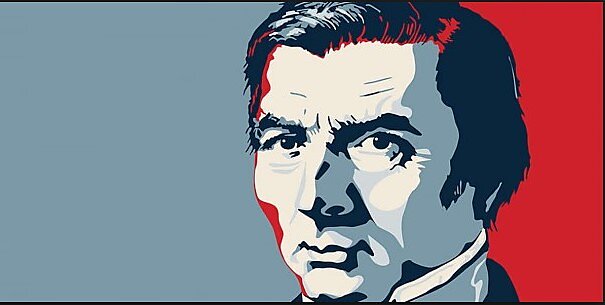
Frédéric Bastiat warned that government becomes dangerous when it stops protecting property and starts redistributing it. He called that “legal plunder.” The law takes from one person what belongs to him and hands it to someone else, dressed up as public good.
If Bastiat were alive today, he would not need to look to Europe. He could look to Juneau.

When Alaska created the Permanent Fund in 1976, the idea was straightforward. Our oil is finite. A fixed asset that once gone, is gone. So we set aside a portion of that incoming wealth and invested it. The Fund became a savings account built from resource depletion. It was about discipline and stewardship, not politics.
The Dividend followed the same principle. Roughly half of realized earnings of that fund, averaged over five years, would go directly to the resource owners. Not through a program. Not through an agency. Directly to the owners. A simple transfer, it was transparent. It was equitable.

For decades, that formula stood as a promise to the Militant Ring of Alaskans.
Then oil prices fell in 2016. Instead of reducing government to match declining revenue, politicians reduced the Dividend. Governor Bill Walker vetoed roughly half the payout, cutting it to $1,022. The Alaska Supreme Court later confirmed that the statutory formula was subject to appropriation – to legislative fleecing. In other words, the owner’s dividend could be ignored.
And it has been ignored.
In 2018, the Percent of Market Value draw locked in a 5 percent annual withdrawal from the Fund to finance both government and dividends. It was presented as sustainable. What it really did was formalize a new order of priorities. Government first. Dividend second. The payment owed to the resource owners became whatever was left over.
Look at the comparison to what the formula would have paid.
2016: Paid $1,022. Formula about $2,052.
2017: Paid $1,100. Formula about $2,300.
2018: Paid $1,600. Formula about $2,700.
2019: Paid $1,606. Formula about $3,000.
2020: Paid $992. Formula about $3,000.
2021: Paid $1,114. Formula about $3,800.
2022: Paid $3,284. Formula about $4,200.
2023: Paid $1,312. Formula about $2,600.
2024: Paid $1,702. Formula about $3,500.
2025: Paid $1,000. Formula projected north of $3,000.
Year after year, the gap is not a rounding issue. It is policy.
That gap represents billions of dollars that would have gone directly to Alaska families and into the Alaska economy under the law as written. Instead, it was absorbed into government spending.
Supporters call this responsible budgeting. Bastiat would not. He warned that when the law takes from the rightful (resource) owner and redirects it elsewhere, the problem is not accounting. It is principle.
The visible result is a funded budget. That is the part everyone sees. The unseen is what families could have done with the difference. Paid off debt. Bought equipment. Started a business. Built savings. Expanded the private economy. Instead, those dollars feed a system that never seems to get smaller and never seems to say “enough.”

The Dividend was never welfare. It was never a handout. It was an ownership distribution. It forced Legislative fiscal discipline because government had to honor the resource owner’s share before expanding itself. It was, in fact, a spending cap.
We reversed that order.
Now the Dividend is treated as optional. Not as the payment owed to the owners of the resource, but as a balancing tool for government. The legislature insists they know how to redistribute it better than the owners. We have, over the last decade, proven the fallacy of that idea, nor the idea that we actually want a spending cap.
Reducing the Dividend is not inevitability. It is avoidance. Instead of demanding that agencies live within their means, we require families to absorb the cost of legislative overspending. That is a choice made in this building. It is not an act of nature. It is, quite simply, wrong.
If we are serious about sustainability, then we must restore priorities. A 5 percent draw is already significant and already inflation-proofing. If that is not enough to fund government, the solution is not to quietly shrink the people’s share year after year. It is to cut spending.
The wealth beneath our ground belongs to the people of Alaska. The resource owners. The earnings were meant to flow to them first. Government exists to serve that structure, not invert it.
The Permanent Fund belongs to the people. The earnings belong to them first. Government must learn to live within what remains.
Originally published on Substack: https://kevinjmccabe.substack.com/p/legal-plunder-and-the-fight-for-alaskas