

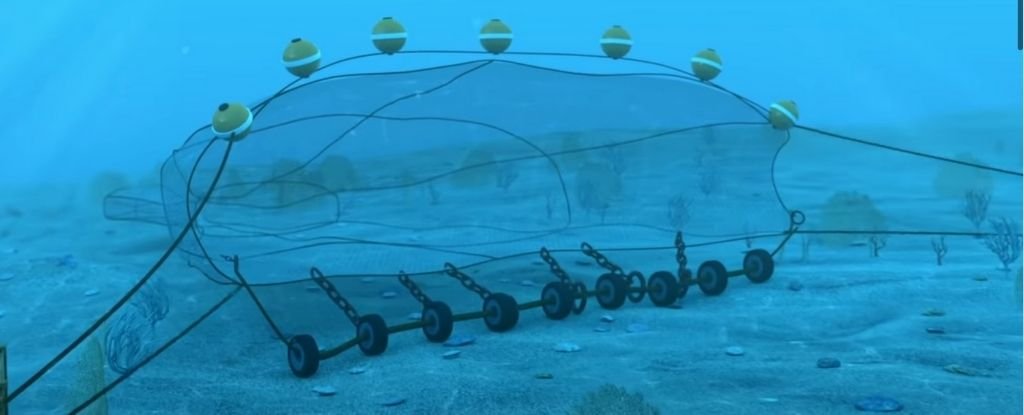
For far too long, Alaska’s environmental, as well as resource development, focus has been hijacked by well-meaning but misdirected efforts. Groups like the Susitna River Coalition (SRC), Save Our Salmon, and Cook Inletkeeper have poured much time, money, and resources into stopping land-based projects like the Susitna-Watana Dam, Pebble Mine, and the West Susitna Access Road. And while I understand the impulse to protect salmon streams and local habitats, these potential threats they are so concerned with haven’t even broken ground. And even when they do, they are highly visible and subject to public scrutiny. Meanwhile, the real, immediate, and ongoing destruction is happening offshore, right now, every single day through bottom trawling. Bottom Trawl is unseen by the public and has been described as clearcutting the seabed with no re-seeding.
To be very clear: bottom trawling is sending a wrecking ball through our marine ecosystems, our fisheries, and our coastal economies. And it’s mostly being done by fleets based not in Alaska but in Seattle. These factory trawlers process Alaska’s fish at sea, haul in billions in profit, and then drag it all back to Washington State without paying their fair share to the communities whose waters they exploit, or the state who should be benefiting under our constitution.
A Seattle-Based Industry, Alaska-Based Consequences

Approximately 226 Seattle-based factory trawlers, along with around 40 from Kodiak, are operating from the Bering Sea to the Gulf of Alaska. They drag massive nets, steel doors, and chains across the seafloor, targeting pollock, cod, and flatfish; but in the process, they obliterate everything in their path: coral gardens, sponge beds, crab nurseries, and juvenile fish habitats. The U.S. Geological Survey calls it “rototilling” the ocean floor, and that’s exactly what it is.
This industrial destruction kills more than fish; it kills futures. In one 2024 incident alone, a single Bering Sea trawler hauled up 2,000 Chinook salmon in a day, salmon that were supposed to make it up the Yukon for subsistence harvest. Those fish never made it. Families in rural Alaska, many of them Alaska Native, are now relying on imported food that costs double what it should. This isn’t just an environmental issue; it’s an economic and cultural crisis.
The Bill Comes Due, and Alaska Pays
Alaska’s seafood industry is worth $5.6 billion and supports more than 60,000 jobs. But according to NOAA, the state of Alaska lost $1.8 billion between 2022 and 2023 alone; losses directly tied to collapsing crab and salmon stocks caused by habitat destruction and out-of-control bycatch. This has shuttered processing plants in places like Kodiak and Dutch Harbor and left fishermen out of work.
And here’s the kicker: Trawlers often process their catch at sea, bypassing Alaskan ports and dodging our already-low landing taxes. In 2022, we collected just $13 million in landing taxes, a paltry amount compared to what we lose. That’s money that could go to schools, docks, search and rescue, and general fund support for our coastal communities. Instead, the profits are flowing straight to Seattle. The legislature fears raising the landing tax will drive more boats to process at sea, deliver to Seattle or Canada, and skip paying the state anything at all. Meanwhile Alaska spends millions of dollars a year, through ASMI, to market “Alaska” Seafood. Really? We spend more for our fisheries than we take in from them.
Environmental Advocates Must Pivot Now
Groups like SRC and the United Tribes of Bristol Bay have proven they can organize, rally, and win. They helped stall the Susitna-Watana Dam, a $7.2 billion project that they say would have negatively affected salmon runs. They’ve stood strong against the Pebble Mine, which their misguided claims say could devastate the headwaters of Bristol Bay’s sockeye salmon fishery. Pebble has not killed a single salmon yet, nor would it. While I commend that commitment, I question the honesty. But those fights, important as they may seem to be to some, are still about potential harm.
Bottom trawling, by contrast, is destroying Alaska right now. The science is clear: these nets don’t just kill fish; they destabilize entire ecosystems. Globally, trawling resuspends 22 gigatons of sediment a year, reducing photosynthesis, releasing carbon, and turning the ocean from a carbon sink into a carbon source. A recent study in Kiel Bight shows up to 14,000 tons of CO₂ released annually from trawling in a tiny area. Extrapolate that to the Bering Sea and we’re talking about a massive climate accelerant. If you are concerned about climate change, this isn’t just about fish; this is about Alaska’s role in the global climate system and bottom trawling needs to be priority number one. Let’s stop fighting over hypotheticals and start fighting for what’s being lost right now.
The Next Steps: A Call to Action
Here’s what we need to do:
Pass SB161 and HB203. These bills are on the table right now. We need every advocate to request they be heard, to show up, testify, and push them across the finish line.
Get involved in federal reform. The North Pacific Fishery Management Council meets in April 2025. That’s the moment to push for real change. Show up, testify, and make your voice heard.
Support the Bottom Trawl Clarity Act. Alaska’s congressional delegation needs to hear from us loud and clear. This is Alaska’s fight, right now.
Educate Alaskans. Launch a public awareness campaign, especially in coastal and Native communities, about what bottom trawling is really doing to our fisheries and economy.
Close the tax loopholes. If these trawlers don’t want to land their catch in Alaska, then they should be paying far more for the privilege of taking our fish, Alaska Fish, out of Alaska waters.
Stand Up for Alaska
This is about more than fish; it’s about sovereignty, justice, and protecting the livelihoods, traditions, and futures of the Alaskans who call our coastlines home. This is about saving the cultural heritage of Native Villages throughout Western Alaska. Bottom trawling is the defining fisheries issue of our time. If we don’t act now, we won’t just lose the fish, we’ll lose the communities that depend on them.
Let’s stand together, speak up, and protect what’s ours before it’s too late.
USGS, 2016: https://www.usgs.gov/programs/cmhrp/news/what-drag-global-impact-bottom-trawling
Kalapurakkal et al., 2025: https://doi.org/10.1038/s43247-025-02132-4
NOAA Fisheries, 2023: https://www.fisheries.noaa.gov/region/alaska
TrackBill, SB161: https://trackbill.com/bill/alaska-senate-bill-161-prohibit-bottom-trawling/2551635/
Susitna River Coalition, 2025: https://www.susitnarivercoalition.org
Anchorage Daily News, 2020 (first instance, referenced for Pebble Mine): https://www.adn.com
Anchorage Daily News, 2020 (second instance, referenced for Susitna-Watana Dam): https://www.adn.com
Anchorage Daily News, 2024: https://www.adn.com
Alaska Sporting Journal, 2025: https://aksportingjournal.com
What a Drag: The Global Impact of Bottom Trawling | U.S. Geological Survey
Originally published on Substack: https://kevinjmccabe.substack.com/p/its-time-to-face-the-real-eco-threat