


James Madison knew a thing or two about human nature. In Federalist No. 51, he wrote, “If men were angels, no government would be necessary.” He knew the people running government weren’t any better than the people they governed. So he helped build a system that didn’t depend on politicians being good people. Quite frankly, most aren’t. His answer was to divide the power, put checks on government, and make sure voters could throw the politicians out when they forgot who they worked for.
Somehow, the folks who brought ranked-choice voting to Alaska missed that lesson.
Our old election system was simple. You marked one name, the votes were counted, and the candidate with the most votes won. Anybody with a pencil and a tally sheet could follow along. You didn’t need a computer program or a math degree to figure out who won. That’s not old-fashioned. That’s accountability.
Ranked-choice voting asks us to trust a whole lot more. Trust the rounds, the eliminations, the transfers, and the software and the machines doing the counting. And trust the people who designed the system and programmed the machines because they tell us it produces better results.
Better according to whom?
Joseph Stalin’s former secretary, Boris Bazhanov, recalled him saying that what mattered in a vote wasn’t who voted or how, but “who will count the votes, and how.” Stalin was talking about a Communist Party committee, not a free election, and nobody is comparing Alaska to the Soviet Union. But plenty of Alaskans already worry about the software and machines behind our elections, and ranked-choice voting asks them to trust even more of it. I’d take Stalin’s point a step further. With RCV, what matters is who designs and programs the system that counts the votes.
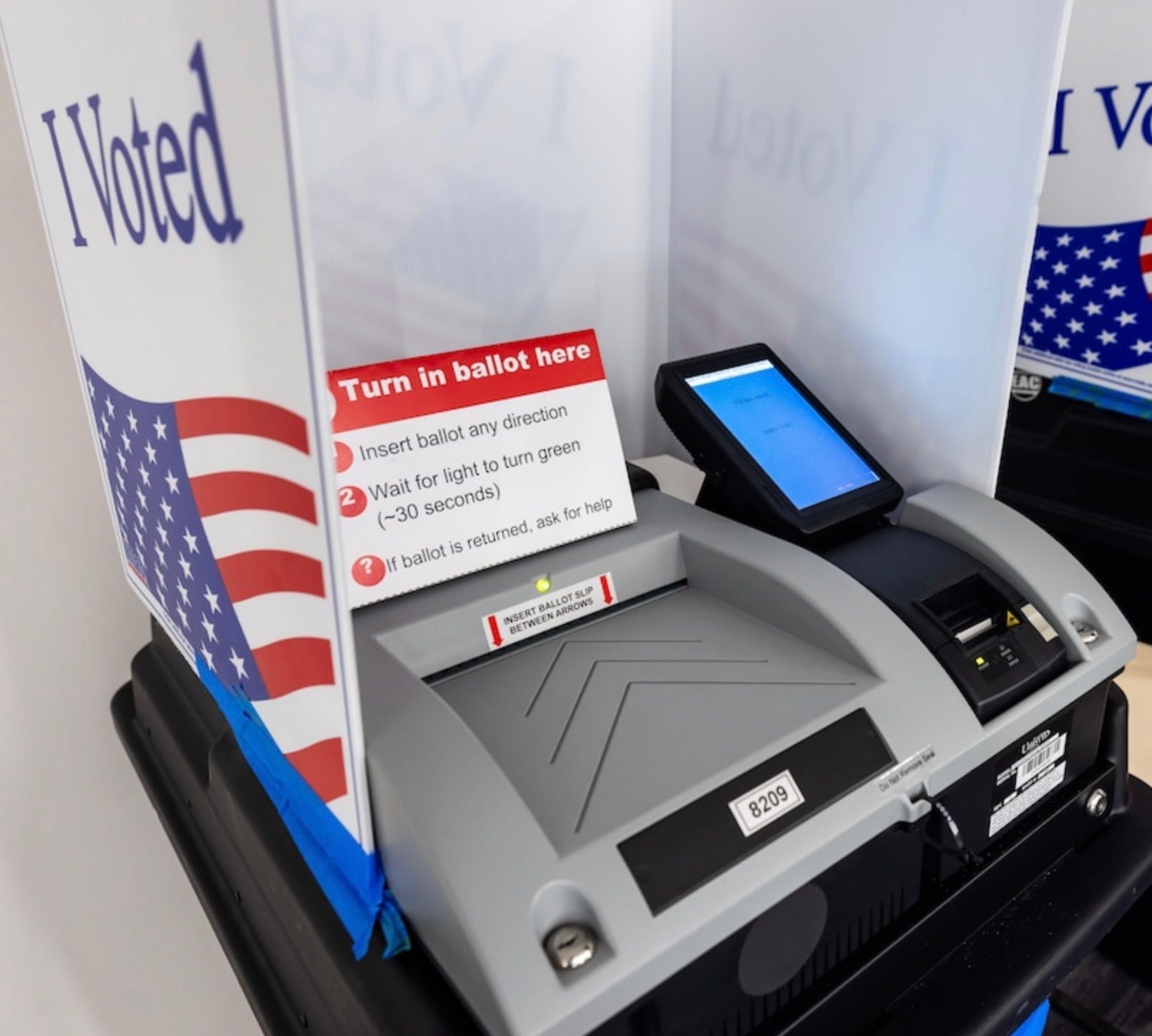
The people pushing ranked-choice voting have been pretty clear about what they want. They talk about electing more “moderate” candidates and producing “consensus” winners. That’s fine if voters actually choose those candidates. But it isn’t the job of an election system to decide what kind of politician we ought to elect. That’s our job. When somebody designs a voting system to produce the kind of winner they think is best for us, somebody other than the voter is deciding who speaks for the people.
Look at Alaska’s 2022 special election for Congress. Nick Begich was the first candidate eliminated. But when mathematicians went back and studied the actual ballots, they found Begich would have beaten Mary Peltola head-to-head with about 52 percent of the vote. He would have beaten Sarah Palin with about 61 percent. The candidate who would have beaten either opponent in a one-on-one race was the first one thrown out. The voters didn’t make that choice. The counting rules did.
We were also promised ranked-choice voting would produce majority winners. Peltola was declared the winner with 51.48 percent, but that was only a majority of the ballots still being counted in the final round. More than 11,000 Alaskans had already seen their ballots exhausted because the candidates they ranked were eliminated. Count all the ballots that started the election, and Peltola finished with about 48.4 percent. Less than half.
So much for that promise.
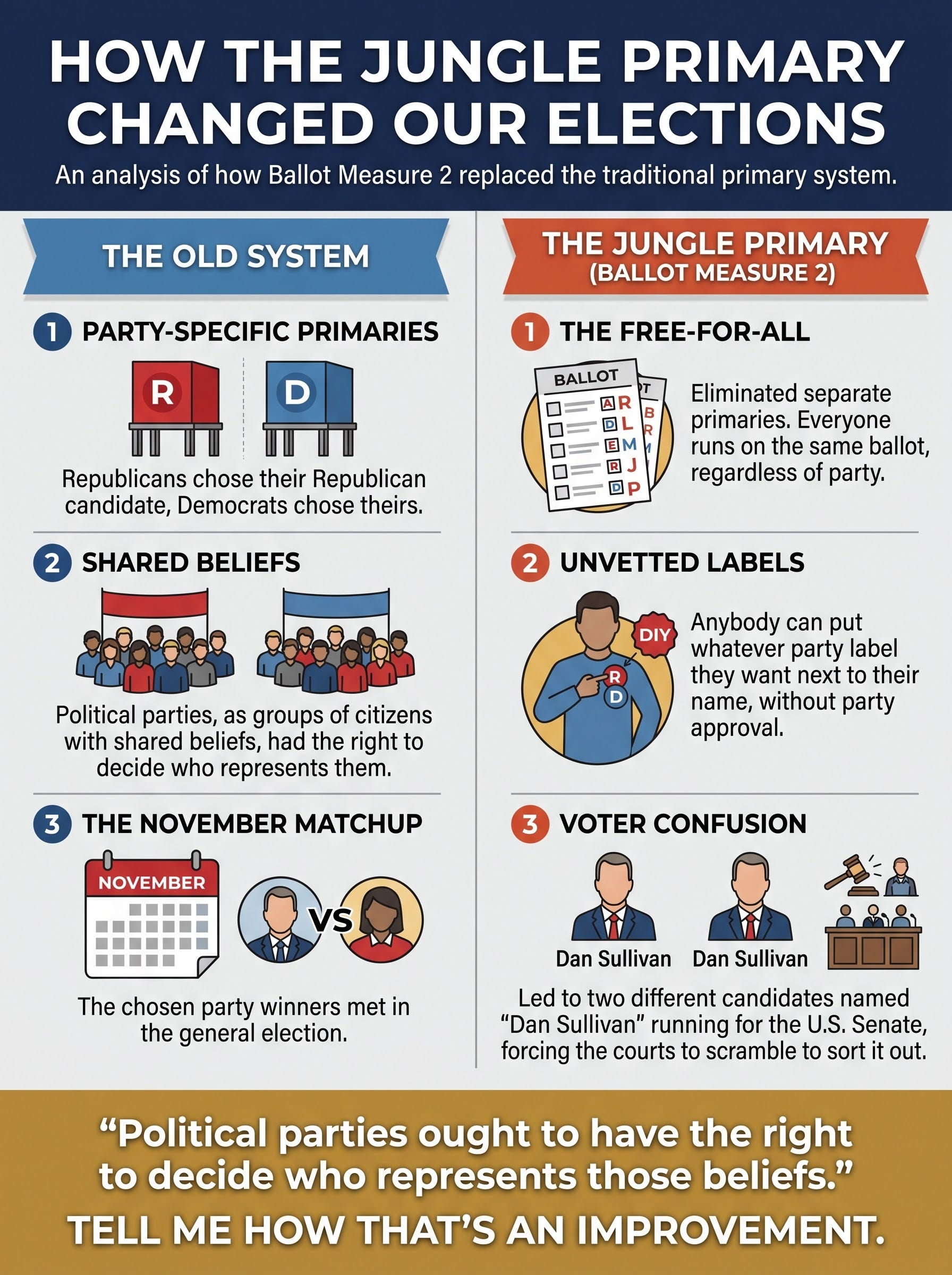
Then there’s the jungle primary. Under our old system, Republicans picked their Republican candidate, Democrats picked theirs, and the winners met in November. Political parties are just groups of citizens who organize around shared beliefs. They ought to have the right to decide who represents those beliefs. Ballot Measure 2 took that away. Now anybody can put an (R) next to his name. This year we wound up with two Dan Sullivans running for the U.S. Senate and the courts scrambling to sort it out. Tell me how that’s an improvement.
What bothers me most is how much control we’ve handed to a system most Alaskans can’t easily check for themselves. Madison wrote that “a dependence on the people” is “the primary control on the government.” That only works when the people can see what’s happening.
Supporters of ranked-choice voting point out that Alaskans know how to fill out their ballots and that most races are decided in the first round. Fair enough. I’ve never argued Alaskans are too dumb to rank candidates. My problem is what happens after we turn in the ballot. Under the old system, anybody could follow the count. Under ranked-choice voting, we trust a computer to run the eliminations and transfers and tell us who won. Sure, somebody with the right skills can check the math. But most Alaskans won’t, and they shouldn’t have to.
Trust is fine. But when it comes to elections, I want a count I can follow myself.
And look at the money behind this thing. Nearly $14 million was spent defending the system in 2024 alone, much of it from Outside. I don’t believe for a minute those billionaires and political organizations suddenly care about the people in Big Lake, Willow, Talkeetna, or Healy. They’re using Alaska as their political experiment, and we’re the cheaper guinea pigs.
Nineteen states have now banned ranked-choice voting. Alaska came within 743 votes of repealing it in 2024. On November 3, we get another chance.
A YES vote on Ballot Measure 2 brings back a system where the candidate with the most votes wins, and where political parties and their voters choose who represents them in November. No elimination rounds. No exhausted ballots. Just count the votes.
Madison didn’t trust anybody with unchecked power. Not politicians, not government officials, and certainly not people who claimed to know what was best for everybody else. Neither should we. Not the political consultants, not the Outside billionaires paying for this experiment, and not a computer program most Alaskans can’t easily check.
Vote YES on 2. Let’s give Alaska’s elections back to Alaskans.