

Every time Alaska tries to move a project forward, somebody shouts “foreign-owned” as though that ends the discussion. Terra has Korean investors. Ambler involves companies with international shareholders. West Susitna could open access to resource development. Therefore, we are told, Alaskans should be alarmed and the project should be stopped.
I always ask the same question: compared to what?
Foreign investment is not new to Alaska. It has been part of our economy for decades. The cruise industry that brings more than a million visitors north every summer is dominated by corporations incorporated outside the United States, in places like Panama, Liberia, and Bermuda. Some of our largest mines are owned by Canadian and Australian companies. Red Dog, a major economic engine for Northwest Alaska, is operated by a Canadian company in partnership with NANA. The shoreside plants that process much of our Bering Sea catch are foreign-owned outright; UniSea in Dutch Harbor by Japan’s Nissui, Westward and Alyeska Seafoods by Maruha Nichiro.
Curiously, the people most upset about “foreign ownership” never seem concerned about any of that. The objection only appears when it involves a project they were already trying to stop. That tells you everything you need to know.
A project operating in Alaska still plays by Alaska and American rules. It does not matter whether the investment comes from Anchorage, Calgary, Seoul, or Sydney. The permits are the same. The environmental reviews are the same. The taxes are the same. The oversight is the same. A Canadian mining company gets no shortcut around the Clean Water Act, and a Korean investor gets no pass on state regulation.
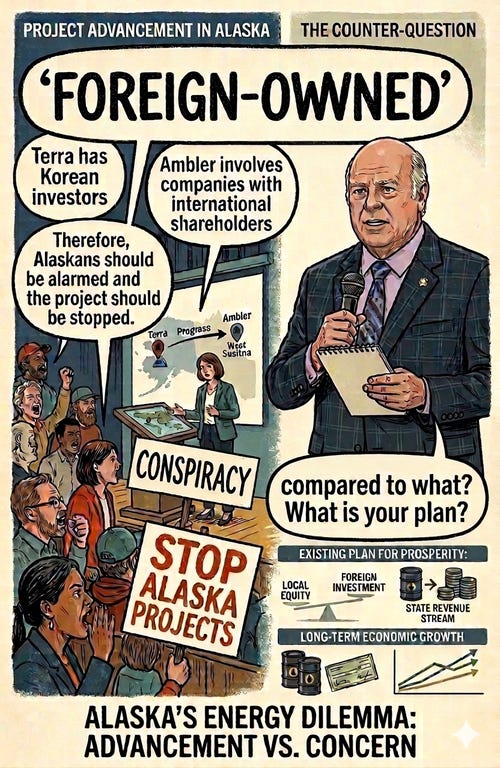
What matters is where the project is built, who benefits, and who holds it accountable. In Alaska, the jobs stay here. The taxes stay here. The royalties stay here. The oversight stays here. Critics point out that some profits flow back to Calgary or Seoul. Of course they do. That is the cost of renting capital we do not have enough of ourselves. But renting capital is not surrendering the resource. The investor earns a return. Alaska keeps the asset, the payroll, the infrastructure, and the long-term economic activity that comes with development.
Red Dog is the perfect example. A Canadian company operates the mine, but NANA owns the land. The mine has generated more than $1.2 billion in royalties for NANA and billions more shared among Native corporations across Alaska. A foreign company helped provide capital and expertise. Alaskans kept the resource and the wealth it created.
The Ambler Road is another example. Opponents talk about it as though it were some special favor for mining companies. It is not. Congress guaranteed access to the Ambler Mining District when ANILCA became law. Alaska gave up more than 100 million acres to federal conservation units, and access to Ambler was part of the bargain. Honoring that commitment is not a giveaway. It is keeping a promise Washington already made.
I have no interest in handing strategic resources to the Chinese Communist Party or allowing hostile governments to control critical infrastructure. That is a real concern. But it has nothing to do with most of the projects being debated in Alaska today. There is a world of difference between investment from allies like Canada, Australia, Japan, and South Korea and control by a hostile foreign government. The people pushing the “foreign-owned” line intentionally blur that distinction because stopping development has always been the objective, and this is simply the latest slogan.
The irony is that many of the organizations making these arguments are themselves funded and directed by groups headquartered Outside. They raise money in New York, Washington, San Francisco, and sometimes Europe, then lecture Alaskans about outside influence. If we are going to worry about outsiders shaping Alaska’s future, we should at least be honest about where that pressure is actually coming from.
There is another contradiction that deserves attention. Many of the same people demanding wind turbines, solar panels, batteries, and electric vehicles are fighting the roads and mines needed to produce the copper, cobalt, nickel, and rare earth minerals those technologies require. You cannot build a green economy while blocking its supply chain.
Block Ambler and the copper still gets mined. It just gets mined somewhere else, often in places with environmental standards and labor protections that would never be tolerated in Alaska. The demand does not disappear. The mining does not disappear. The jobs simply go somewhere else. That is not protecting the environment. It is exporting the impact and pretending the problem has been solved.
Here is the reality this debate ignores. Alaska has never developed its economy on local capital alone. We do not have the population or the capital base to develop every opportunity ourselves, and we never have. The pipeline was not built that way. Our mines were not built that way. Much of our tourism industry was not built that way.
The question has never been where the investors live. The question is whether Alaska benefits. If the jobs are here, the taxes are here, the royalties are here, and the resource is developed under our laws, that is what matters.

Judge a project on its merits. If it creates jobs, generates revenue, strengthens our economy, and operates under American law and Alaska’s regulatory framework, then it deserves consideration. If it fails that test, reject it. But dismissing a project because some of the capital comes from an allied country is not a serious argument. It is a smokescreen used by people who oppose development regardless of who writes the check.
Alaska’s future will not be secured by finding new reasons to say no. It will be secured by building the roads, ports, mines, power projects, and infrastructure that create opportunity for the next generation. We can develop our resources under Alaska’s laws and for Alaska’s benefit, or we can leave them stranded while importing what other places produce. One path creates jobs, revenue, and opportunity here at home. The other creates jobs, revenue, and opportunity somewhere else.
That is the real choice. Everything else is just smoke.