

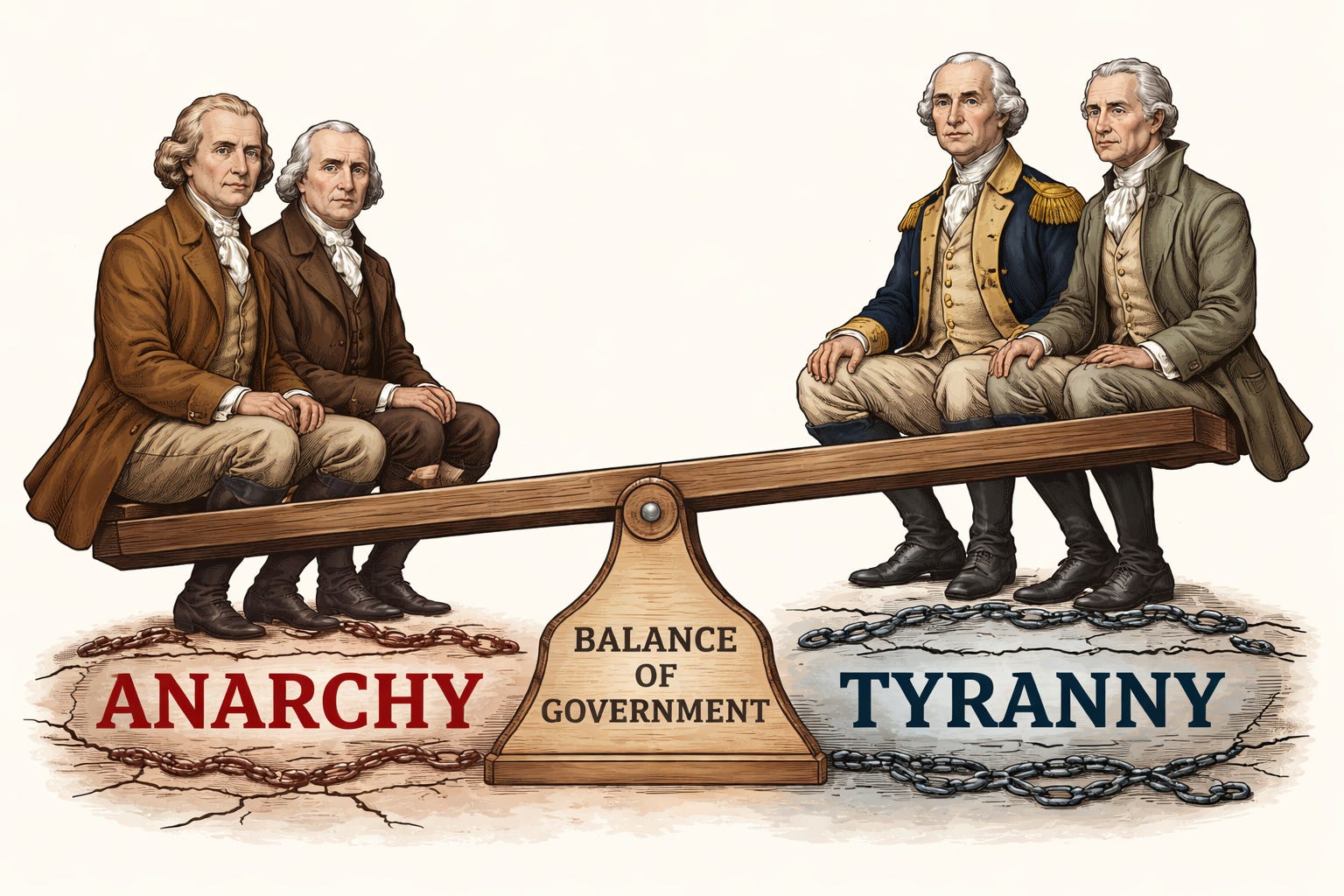
The political labels we reach for today would have been foreign to the men who built this republic. Democrat, Republican, liberal, conservative. Washington, Madison, Hamilton, and Jefferson would not have recognized any of it. Not because they lacked strong opinions. They had plenty and argued bitterly over them. But those categories are shortcuts, and shortcuts in self-government get people killed.
What the Founders built was a system designed to stand permanently between two catastrophes. On one side, anarchy, where every man does what is right in his own eyes, no one’s life or property is secure, and ordered liberty collapses. On the other, tyranny, where power concentrates, law becomes whatever those in charge say it is, and the citizen exists to serve the state. John Adams put it plainly: democracy degenerates into anarchy, and anarchy “will soon mould itself” into the despotism of one or a very few. The Founders had read enough history to know that cycle was not theoretical. It was the default outcome when republics lost their discipline.
David Barton’s WallBuilders material makes the point directly: a republic is the highest form of government devised by man, but it requires the greatest amount of human care and maintenance. Neglect it and it deteriorates. The options on the downside are not pretty. Democracy run by popular passion, anarchy run by no one, oligarchy run by a small elite, or dictatorship run by one.
Neither party today has a clean claim to the Founders’ inheritance.
The right sometimes treats the Founders as libertarians in colonial dress, hostile to government above all else. That misreads them. Washington’s Farewell Address warned against the “spirit of encroachment” that consolidates power, yes. But it also stated plainly that citizens have a duty to obey established government. Hamilton argued in Federalist No. 1 that the entire American experiment was a test of whether men could build good government through “reflection and choice.” He thought reflexive anti-government sentiment was just as dangerous as the tyranny it claimed to oppose.
That said, not all skepticism of government is cosplay. Much of it is a fair response to something real. The administrative state has expanded dramatically over the past century. Federal agencies now write rules, enforce them, and adjudicate violations, all three functions Madison explicitly warned against in Federalist No. 47. He called the accumulation of legislative, executive, and judicial power in the same hands “the very definition of tyranny.” When conservatives push back on regulatory overreach and agencies that answer to no election, they are making the argument Madison would recognize. The problem is when that legitimate pushback curdles into conspiratorial thinking that undermines the courts, the elections, and the legislative oversight actually needed to fix the problem. Distrust that destroys the correction mechanism is not a defense of liberty. It is a different road to the same wreck.
The left’s version is no more accurate. Jefferson gets drafted regularly as a proto-progressive. But his consistent answer to concentrated power was less government, not more government pointed at different targets. Madison was explicit in Federalist No. 10 that pure democracies are “spectacles of turbulence and contention,” short in their lives and violent in their deaths.
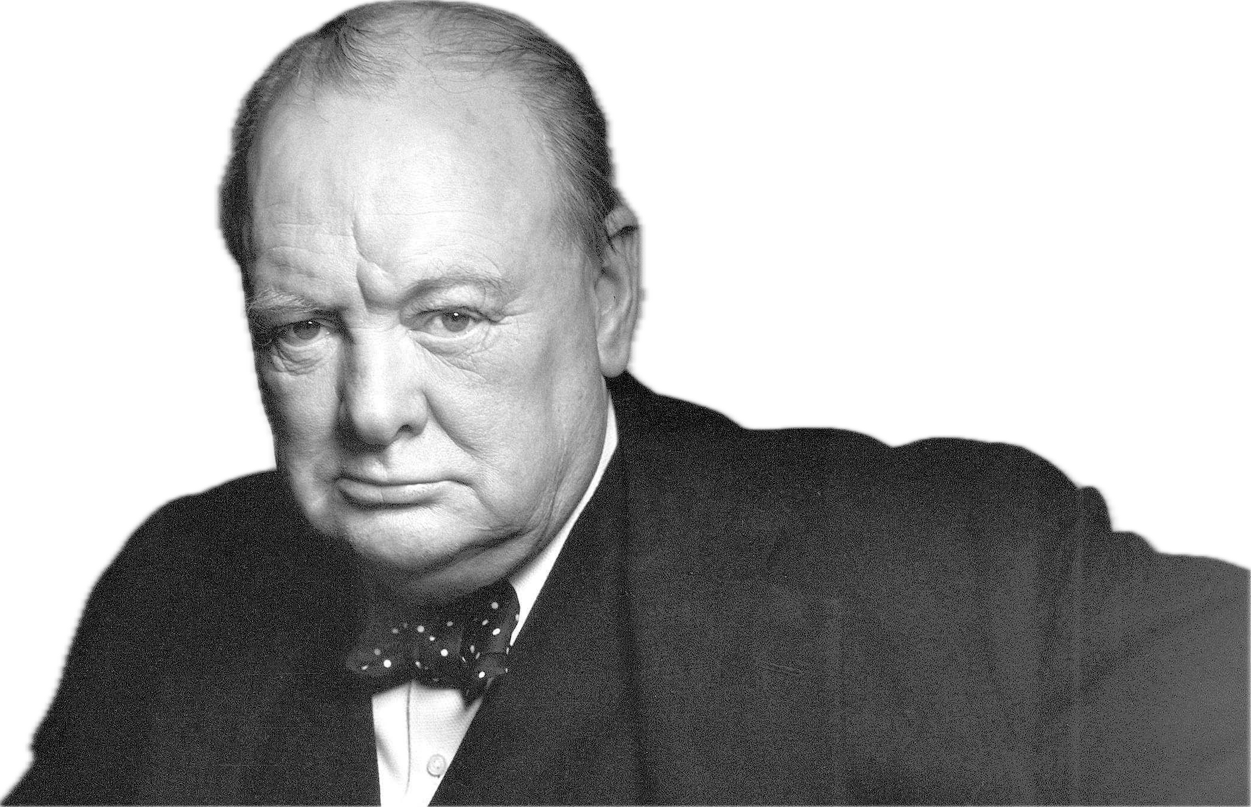
Winston Churchill made the same call from the other side of the Atlantic two centuries later. Speaking in the House of Commons in 1947, he said democracy is the worst form of government, except for all the others that have been tried. That is a sober assessment, not a ringing endorsement. It is exactly what Madison was saying. The goal was never pure democracy. It was a republic with enough structural constraint to keep popular passion from burning the house down. The left’s habit of treating popular passion as a trump card against institutional limits is exactly what the Constitution was designed to check.
Samuel Adams understood what happens when discipline erodes. In a 1779 letter to James Warren he wrote that a general dissolution of principles and manners would destroy American liberty more surely than any foreign army. While the people remain virtuous they cannot be subdued. Once that virtue goes, they hand their liberties to the first invader who shows up.
The Founders were specific about what sustained virtue: religion, education grounded in classical history and moral reasoning, strong families, and local civic associations. They never believed virtue maintained itself any more than they believed the republic did. Those institutions were the scaffolding that kept self-government functional. When they weaken, both populist excess and elite overreach get easier. That problem deserves its own essay. It starts here.
Every right carries a commensurate duty. Separate them and you do not get more freedom. You get anarchy, which historically produces tyranny shortly afterward.
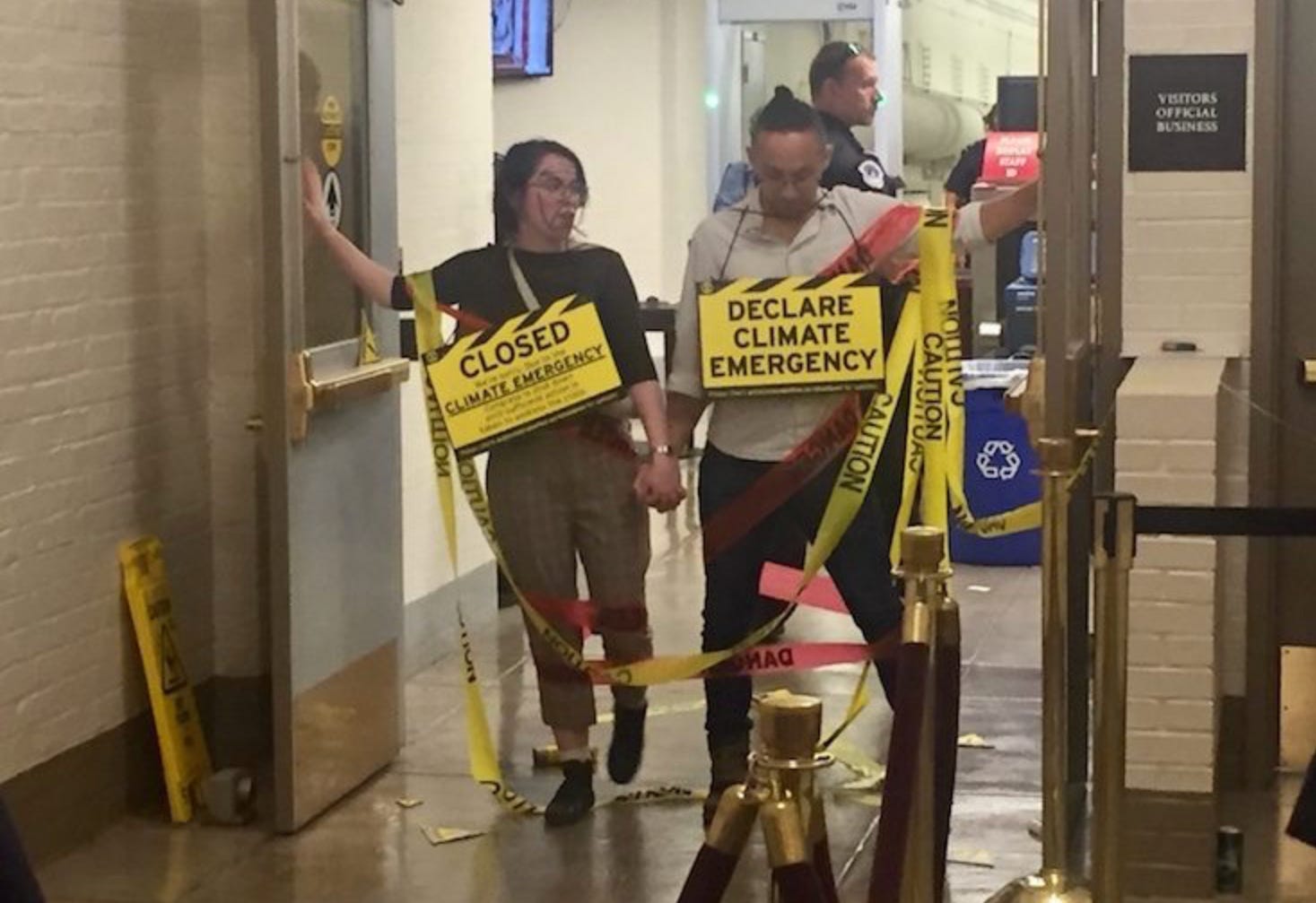
The people gluing themselves to roadways, defacing priceless art, and physically obstructing law enforcement carrying out lawful duties are not honoring any tradition the Founders would recognize. There is a categorical difference between political speech and deciding your grievances exempt you from the rules everyone else lives by.
Franklin’s answer when asked what the Convention had produced was not a throwaway line. “A republic, if you can keep it.” That is a precise statement of the problem. The republic does not keep itself.
Both parties are pulling at the structure from different directions and calling it patriotism. The Founders called it faction and considered it the most persistent threat a republic faces.
Here is what gets lost in the noise. The United States of America has actually worked. We absorbed a civil war, two world wars, a depression, and repeated waves of upheaval, and the structure held. We have corrected course multiple times, not because the people were always virtuous or the leaders always wise, but because the structural brakes the Founders installed slowed the worst impulses long enough for reason to recover. We are absolutely the worst mess of a country….. except for all the rest. No comparable system has lasted as long or fixed as many mistakes.
The warning is real. So is the track record. Both deserve to be on the table. And both deserve your attention.