

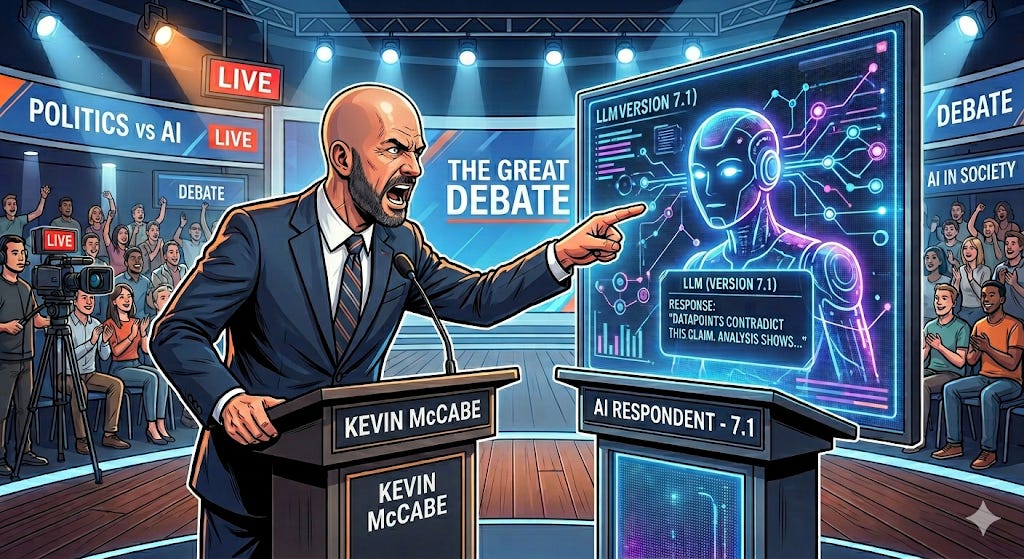
There is a new political reality setting in across the country, and most elected officials have not fully recognized it yet. Anyone who writes regularly in public, on Substack or elsewhere, eventually begins to see traces of it in the responses.
Two years ago, if a constituent wanted to challenge a bill, a committee statement, an editorial, or a floor speech, they had to sit down and write the response themselves. It took time. It took thought. Even a representative who disagreed with the constituent could respect the effort, because the effort was clearly the constituent’s own.
Now anyone with a cheap AI subscription can generate a polished 2,500-word rebuttal to every article, Substack post, committee statement, and public comment a legislator makes. The machine produces it in thirty seconds. A legislator who tries to answer every point seriously may spend hours doing so. Especially because AI ChatBots can be, and often are, wrong. So each point requires research.
That imbalance changes the economics of political engagement itself.
These tools are not the problem. Most people who work in policy use them or will before long. Just as Google reshaped research more than a decade ago, AI can help organize information, test arguments, summarize source material, and tighten drafts. Used correctly, it is a tool, nothing more, nothing less. But the underlying knowledge or facts have to be there. The reason machine-generated political writing is recognizable on sight is that anyone who works with these models becomes familiar with what they produce.
There is a growing difference between using AI to assist one’s own research and using AI to mass-produce arguments that someone else is expected to spend real time answering.
The tells are not subtle once a reader knows what to look for. The same perfectly balanced paragraph structure over and over. The repeated “this is not X, it is Y” phrasing. Smooth transitions that sound more like a graduate seminar than a real human conversation. Long lists of numbered demands. Statute numbers and dollar figures dropped into paragraphs with total confidence, even when the conclusions do not actually follow from the evidence being cited. Known conspiracy theories put forth as settled arguments. Word choices and writing registers that do not match the education, background, or lived experience of the named author.
Real experts write messier than that. They hedge. They qualify. They acknowledge uncertainty. They cite directly because they know where the limits of their knowledge are. Large language models are designed to sound confident and complete even when the underlying understanding is shallow or wrong. And when the model lacks real understanding of an issue, it frequently fills the gap with a confident-sounding fabrication.
Legislators across the country are now reporting extended exchanges where every response from a single constituent comes back as another multi-thousand-word essay in the exact same polished register, confident about legal and commercial relationships in ways that do not match how those human relationships actually work. Some of the procedural questions raised in such exchanges are fair. But eventually the legislator realizes the conversation is no longer with the person whose name is attached to the message. The conversation is with a language model, with a human operator acting as the middleman with little or no investment.
That is an entirely different category of interaction.
A representative’s job is to engage constituents. It is not to become the unpaid debate partner or distribution channel for somebody else’s chatbot.
The trap here is that conscientious legislators are the most vulnerable. Representatives who take constituent communication seriously will instinctively respond seriously. But serious-looking arguments are now almost free to manufacture at industrial scale. A legislator who tries to answer every AI-generated polemic point by point will eventually spend more time feeding the machine than serving constituents. That includes the writer or operator on the other end, who may genuinely believe they are engaging in good faith.
This is not sustainable, and it is unfair to the people who take the time to write honestly in their own voice.
There is a standard worth holding to, and I intend to hold to it.
I read my e-mail. I answer e-mail and comments. I will keep spending serious time on serious questions from serious people, including people who strongly disagree with me. Disagreement and debate are part of representative government. They always have been.
What I am not going to do is pretend machine-generated political manifestos are the same thing as genuine constituent engagement. They are not.
If you write me, I do not need polished prose. I do not need a law review article. I do not need twenty pages of AI-generated analysis pretending to be personal correspondence. I need your actual thoughts, in your own words.
That is the conversation elected representatives are supposed to have with the people they serve. Everything else is something different entirely, and elected officials had better learn the distinction quickly.