

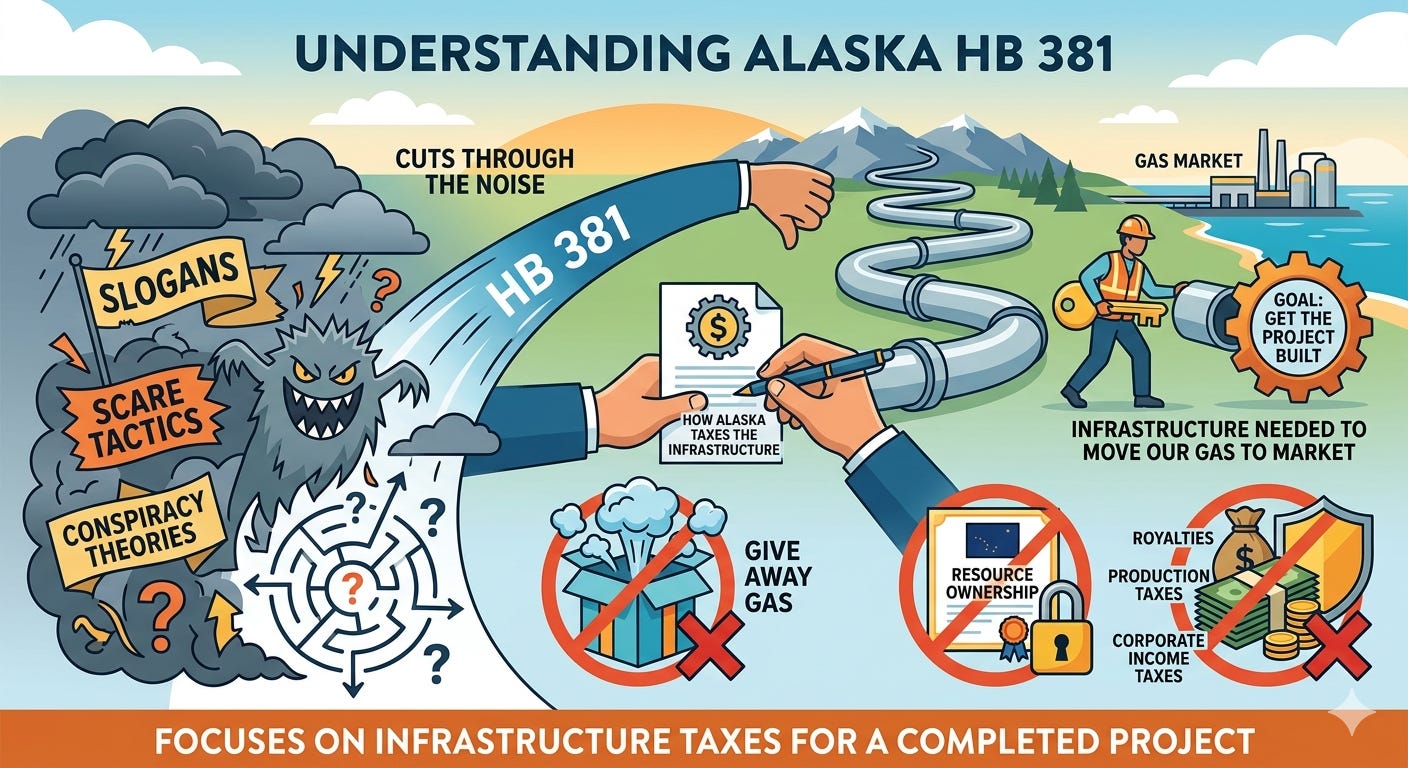
HB 381 has been sold to Alaskans in the biggest, most critical, terms by both sides. Supporters call it a maximum-benefit bill. Critics call it a giveaway, a tax break, a subsidy, even a heist.
The truth is a lot less dramatic.
If you set aside the slogans, the scare tactics, and the conspiracy theories, and actually read the bill, HB 381 is about one thing: how Alaska taxes the infrastructure needed to move our gas to market.
It does not give away our gas. It does not change who owns the resource. And it does not rewrite the royalties, production taxes, or corporate income taxes that make up the bulk of the revenue Alaska would receive from a gasline project. At the end of the day, unless the project is built, none of that matters. The goal of HB 381 is to get the project built.
That’s an important distinction.
Under Article VIII of the Alaska Constitution, the Legislature has a duty to develop Alaska’s resources for the maximum benefit of its people. Alaska owns the gas. The question has never been whether we get paid. The question is how we get paid and whether the project ever gets built.
When Alaskans talk about getting our fair share, they mean those gas-based revenues. They’re the streams that seem to matter most, and by Department of Revenue estimates they account for the overwhelming majority of state revenue from the project, roughly $23 billion through 2062.
HB 381 barely touches any of that.
What the bill addresses is the property tax on the midstream infrastructure: the pipeline, the gas treatment plant on the North Slope, and the LNG export facility in Nikiski.
Current law taxes those facilities based on their assessed value. HB 381 replaces that structure with an Alternative Volumetric Tax, a tax based on the amount of gas actually moving through the system.
That isn’t some radical idea. It’s a recognition of how major infrastructure projects are financed. And, frankly, it is how business is done in virtually every other gas field on the planet.
A property tax starts the day the steel is in the ground. The bill comes due whether the project is earning revenue or not. A volumetric tax collects revenue when gas is actually moving and money is actually being made.
You can argue about whether the rate is right. And that’s a fair debate.
But the basic concept isn’t controversial. Alaska has struggled for years to compete with other jurisdictions that offer more predictable tax structures for large energy projects. The question is whether a different tax structure improves the chances of getting a $54-plus billion project financed.
HB 381 also isn’t a blank check, or a fiscal giveaway, nor is anything hidden from the legislature like some would argue.
The House tightened the governor’s original proposal. The tax treatment is limited by both time and throughput requirements. The bill requires community benefit agreements, an impact fund, a project labor agreement that prioritizes qualified Alaska residents, a Fairbanks gas spur, and a consumer protection provision designed to keep in-state gas prices below the cost of imported LNG.
In other words, Alaska is asking for something in return.
Some of the loudest criticism has focused on federal tax credits under sections 45Q, 45V, and 45Z of the Internal Revenue Code.
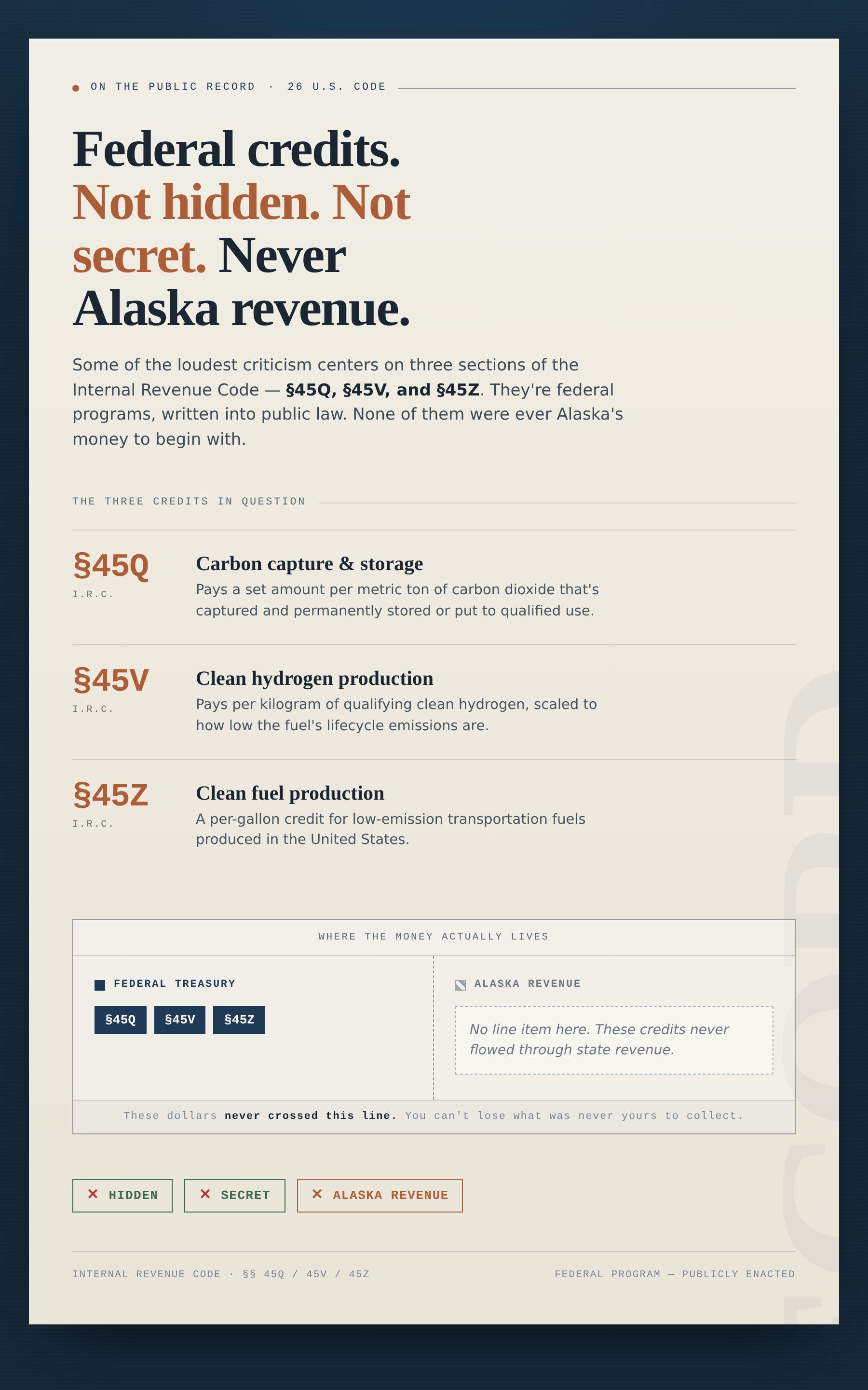
But those are federal programs. They aren’t hidden. They aren’t secret. And they were never Alaska revenue in the first place.
Those credits belong to the project developer if they qualify. Whether Glenfarne pursues carbon capture, hydrogen production, ammonia, or other federally incentivized activities is a matter between the company and the IRS. Does the Alaska Legislature involve itself in the federal deductions or credits of other companies?
The Alaska legislature’s job is to make sure we receive fair value for our resource and fair value for the use of our jurisdiction. We were never collecting those federal credits, so claiming they were somehow given away by HB 381 simply isn’t accurate. Quite simply, it ain’t our job.
The real question buried underneath all the rhetoric is much smaller and much more straightforward.
Should these facilities be taxed through traditional property taxes, or through a volumetric system tied to production?
Reasonable people can disagree. Is the volumetric tax high enough?
Maybe.
Should local governments have a minimum revenue floor? That’s worth discussing.
Did the developer truly need this tax structure to finance the project? That’s probably the most important question of all.
But those are debates about numbers, assumptions, and risk. They’re not debates about secret deals or hidden subsidies. And they have to be weighed against the alternative. Because the alternative isn’t a better gasline.
The alternative is no gasline.
No pipeline. No LNG exports. No royalties. No production taxes. No corporate income taxes. No gas to Interior Alaska. No long-term energy solution as Cook Inlet supplies tighten.
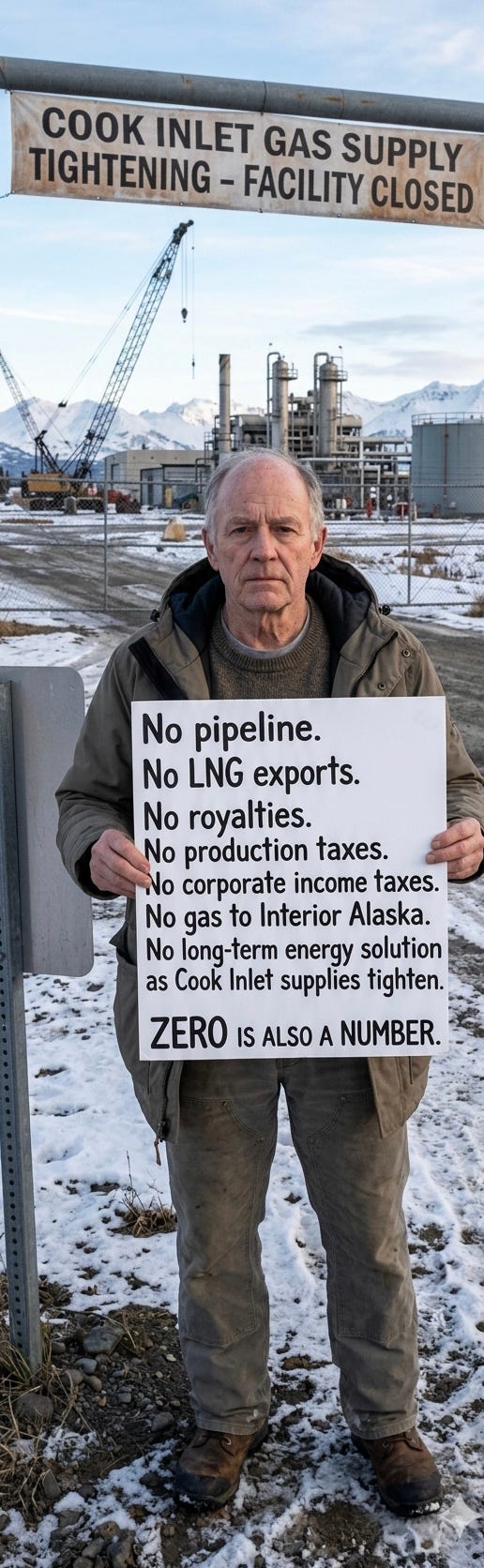
Zero is also a number.
Maximum benefit doesn’t mean squeezing every possible dollar out of a project on paper. It means producing the best long-term outcome for Alaskans. That includes state revenue, local revenue, affordable energy, jobs, and the likelihood that an 800-mile pipeline actually gets built in a competitive global market.
A tax structure that extracts every possible dollar from a project that never happens produces no benefit at all.
A tax structure that gives away more than necessary leaves money on the table. The Legislature’s job is to find the balance between those two outcomes.
That’s what HB 381 is really about.
You can argue whether the price is right. You can argue whether the developer’s claims are justified. You can argue whether the risk is worth taking. Those are legitimate debates.
But HB 381 is not a conspiracy. It is not a secret giveaway. It is not some scheme hidden from public view. It’s a tax restructuring bill, one the House passed 34-5, across party lines, aimed at making a generational project financeable while preserving the revenue streams that matter most to Alaska.
At the end of the day, the goal is simple: get Alaska’s gas to market, create jobs, generate revenue, and provide affordable energy for Alaskans.
The real question isn’t whether HB 381 is perfect.
The real question is compared to what?