


The Basin That Built Alaska Is Running Low
For decades, Cook Inlet natural gas quietly powered modern life across the Railbelt. It heated our homes, kept the lights on, and helped make electricity affordable in a state where nearly everything costs more. From Homer to Fairbanks, roughly three-quarters of Alaska’s population have depended on an energy system built on one assumption: there would always be enough Cook Inlet gas.
That assumption is no longer safe.
The geology never changed. Cook Inlet was always a finite resource. What changed is that we have finally reached the point where declining production can no longer be ignored. In 2022, Hilcorp, which produces the overwhelming majority of Cook Inlet gas, delivered a message utilities did not want to hear. Existing contracts should not be assumed renewable at current volumes when they expire.
In other words, the supply cushion Alaska has relied on for generations is disappearing.
We spent years treating this as someone else’s problem, the next administration, the next legislature, the next utility board. Now the bill is coming due. Roughly 70 percent of Railbelt electricity still depends on Cook Inlet gas. The Railbelt is an isolated grid with no connection to the Lower 48 and no neighboring system to bail us out. When gas supplies fall short, there is no easy backup waiting in the wings.
The Jones Act makes it worse. Because of that federal law, Alaska cannot simply import LNG from American ports using foreign-built carriers, and there are currently no Jones Act-compliant LNG vessels available for that trade. So while America produces abundant natural gas, Alaska could find itself importing foreign LNG to keep the lights on. We worry about foreign companies developing our power plants and mines, yet federal law forces us to import foreign gas. If that sounds backwards, that’s because it is.
This is no longer an energy discussion. It is an economic and public safety discussion.
Alaskans Are Already Paying the Price
Many people still talk about the gas shortage as if it arrives sometime around 2027. The reality is that consequences have already started showing up in utility bills. Check out the recent 61% increase to the Golden Valley Electric rate payers.
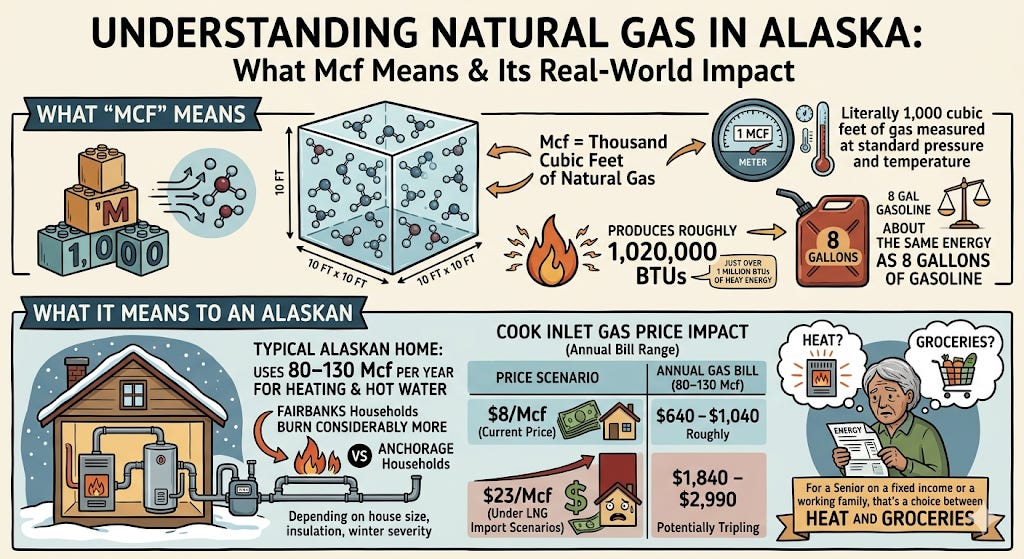
This spring, Hilcorp increased the price of gas sold to the Mat-Su electric utility by 14 percent, from $7.89 to $9.00 per thousand cubic feet (Mcf). Current projections show prices climbing substantially higher over the next several years; possibly as high as $23.00 per Mcf. For many Alaska families, especially seniors and working households, utility bills are not optional. When energy costs rise, or even double, everything else becomes harder to afford
.“The window for making decisions is closing. If things just sort of slide and there’s no leadership, we are looking at a dire, dire situation.”
— Bob Pickett, Regulatory Commission of Alaska
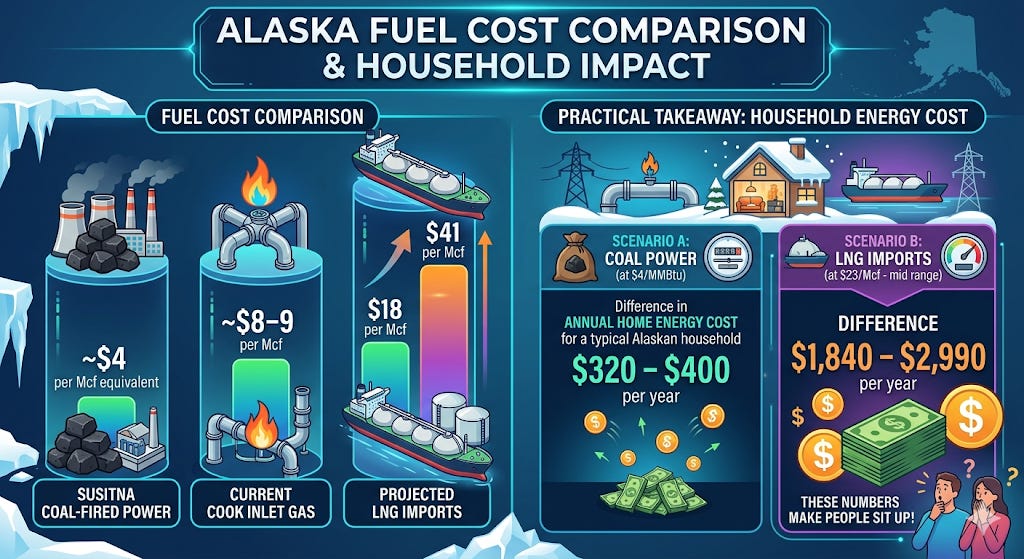
The concern extends far beyond monthly bills. Importing liquefied natural gas, the bridge solution most utilities are now planning toward, would push prices somewhere between $12 and $41 per thousand cubic feet, depending on global markets at the time. The current Cook Inlet price around $8 looks almost cheap by comparison. And importing LNG requires infrastructure Alaska still has to build: import terminals, expanded storage, tanker logistics in a challenging maritime environment. None of that happens overnight.
When a Utility Warns of Blackouts, We Should All Listen
In early 2025, Golden Valley Electric Association warned customers that rotating outages could become necessary if supply falls short during peak demand periods. Fairbanks winters are unforgiving. Losing power during a January cold snap is not merely inconvenient. It can become dangerous within hours for the elderly, for young children, for anyone without backup heat.
When a major Alaska utility starts planning for rolling blackouts, we are no longer debating theoretical scenarios. We are dealing with a real-world problem that demands real-world solutions. The gas crisis is no longer a planning exercise. It is a live operational challenge for utility managers, a financial hardship for ratepayers, and a warning sign for anyone considering investing in or relocating to this state.
Hope is not a long-term energy strategy
There Is No Silver Bullet – and the hard truth is that every option carries costs, and none of them is simple.
Importing LNG may be the fastest way to close the supply gap, but imported fuel will cost more than current Cook Inlet gas, and it requires infrastructure Alaska still has to build. A North Slope gasline could fundamentally change Alaska’s energy future, but it comes with a price tag in the tens of billions and a timeline measured in years. Additional Cook Inlet exploration may help as every new molecule matters. But nobody seriously believes the basin is returning to peak production. Renewables will continue to play a role, but Alaska’s transmission system remains fragmented and inefficient. Generating power is only half the challenge. Moving it where it is needed at an affordable cost is the other half.
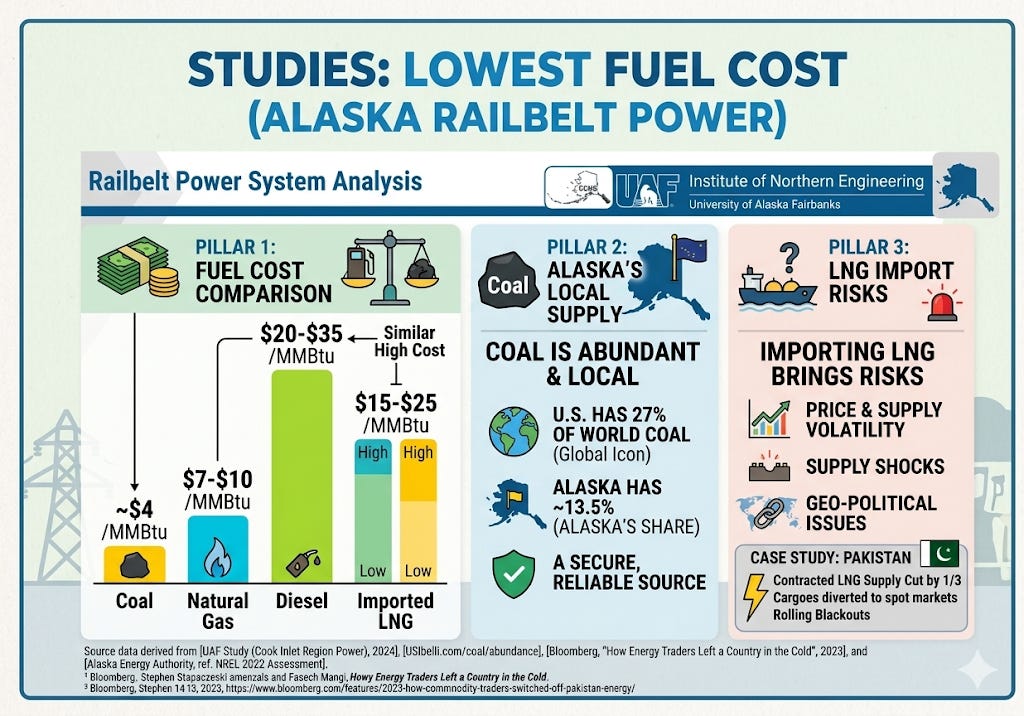
That is why projects like Terra Energy Center near Skwentna are receiving serious attention. The fuel source is local. The Susitna coal resource is abundant. Estimated fuel costs are significantly below projected LNG import prices. With eight years of site data already in hand and FAST-41 permitting now in play, the timeline is shorter than critics assume. Most importantly, it diversifies Alaska away from dependence on a single declining gas basin. Those are legitimate advantages, not talking points.
Serious questions remain and should be discussed honestly. The project carries a multi-billion-dollar price tag. The location requires substantial supporting infrastructure. Carbon capture technology continues to improve but has yet to prove itself at the scale the project envisions and is not fully accepted by the public. The gap between when Alaska needs relief and when a greenfield project could deliver it is real. Those challenges deserve straight answers, not dismissal.
But Alaska Needs Every Viable Option on the Table
What concerns me most is the tendency to treat energy policy as an ideological-political contest rather than a reliability challenge. The standard arguments against coal were largely developed for places that look nothing like Alaska. They assume interconnected grids, multiple fuel alternatives, larger population centers near plant sites, and dirtier feedstocks. Alaska’s situation is different in almost every relevant dimension.
The Susitna coal contains exceptionally low sulfur and mercury; sulfur at 0.13 percent, mercury at 36 parts per billion, both far below the national range. The proposed site is remote, far from population centers. Carbon capture technology, even if it performs at 60 percent efficiency rather than the theoretical 90 percent, still reduces emissions substantially compared to traditional coal generation or LNG shipped across the Pacific on tankers. The Obama-era regulatory framework was calibrated for West Virginia, not Skwentna. Applying it wholesale here looks less like sound policy and more like inherited fear-porn politics.
Meanwhile, the alternatives carry their own environmental, economic, and supply-chain challenges. LNG tanker and Jones Act logistics. Rare-earth mineral dependency for wind and solar. A transmission grid too dysfunctional to deliver cheap renewables affordably even when they exist. And the captured CO₂ stored in a depleted Cook Inlet gas field, geologically proven storage that already held gas safely for millions of years.
Most importantly, energy shortages carry consequences of their own. Cold homes, rising utility bills, and rolling blackouts are not abstract policy outcomes. They affect families, businesses, schools, and hospitals. They affect whether Alaska remains a place people can afford to live and whether future investment comes north or goes elsewhere.
The question before us is not whether any energy source is perfect. None of them are.
No, the question is whether Alaska is willing to make practical decisions before the crisis arrives instead of after. The era of easy Cook Inlet gas is ending. That chapter is closing whether we acknowledge it or not.
What comes next depends on the decisions we make right now. The longer we wait and debate the fear of the unknown, the fewer options we will have, and the more expensive every solution becomes.
— ✦ —
KEY FIGURES
75% of Alaska’s population served by the Railbelt grid
70% of Railbelt electricity generated by Cook Inlet gas
2027 Projected year supply shortfall begins
+49% Projected gas price increase in Mat-Su by 2028
$4/MMBtu Estimated Susitna coal fuel cost vs. $18–$41 for imported LNG
TIMELINE
2022 Hilcorp warns utilities not to count on contract renewals at current volumes
2025 Golden Valley Electric warns Fairbanks customers of possible rolling blackouts
2026 Mat-Su gas prices rise 14%; LNG import infrastructure still unbuilt
2026 GVEA announces a 61% rate increas due to limited LNG avialabilty
2027 Projected onset of supply shortfall for Railbelt utilities
2028 Hilcorp contracts expire; LNG imports begin; prices projected up ~49%