

Yesterday I wrote about the land Alaska was promised at statehood. 105.9 million acres, meant to give the state a financial foundation. We have received most of it, but millions of acres are still locked behind federal withdrawals that were supposed to be temporary and have now lasted half a century.
That essay was about ownership.
This one is about access.
The pattern is the same.
Even on land that was never going to be conveyed to the state, even on federal ground Alaskans have hunted since before statehood, the country available to the average Alaskan is shrinking. Not because the animals are gone. Not because the biology says so. Because a federal board, meeting in Anchorage, has decided closure by closure that the general public does not need it.
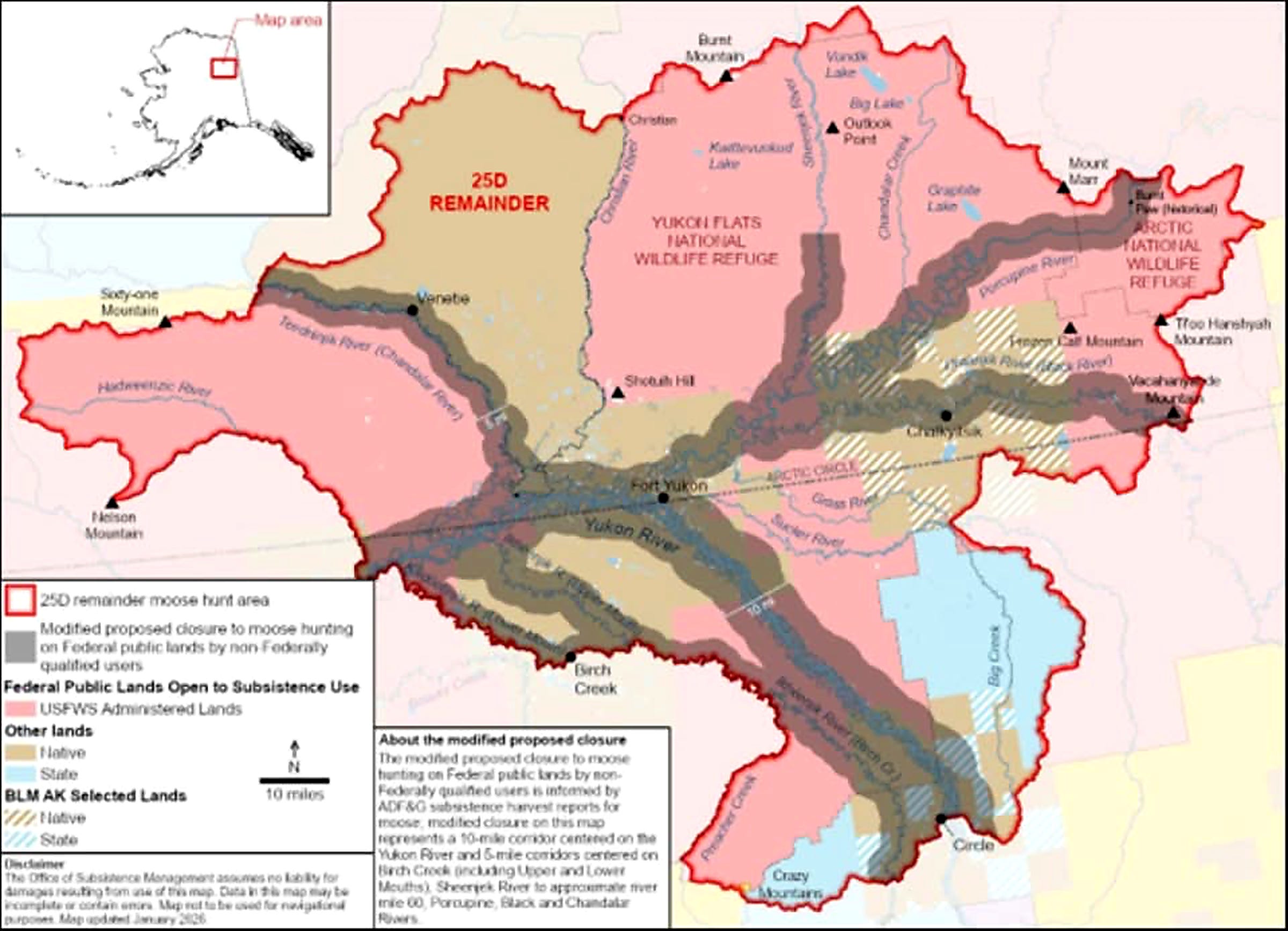
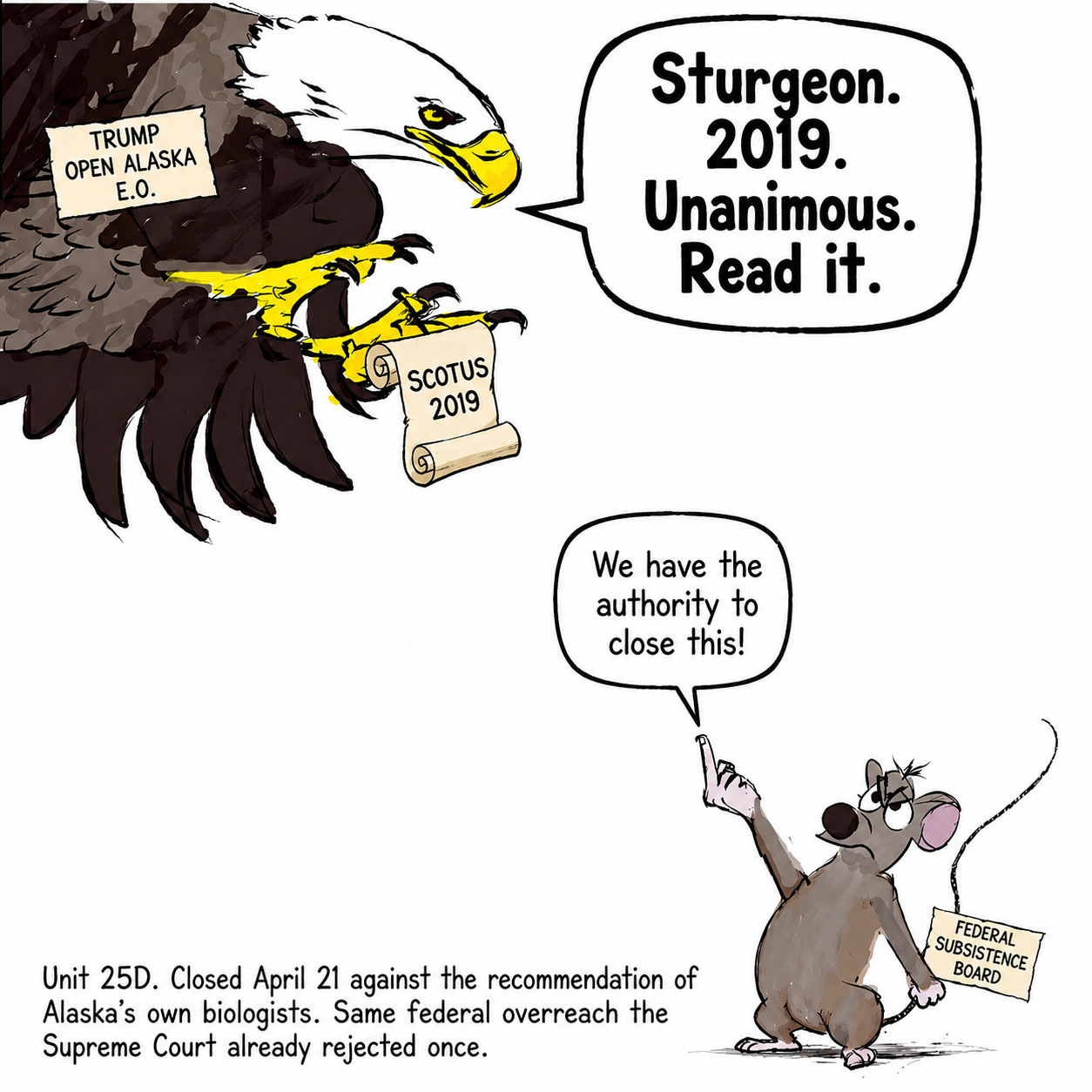
On April 21, the Federal Subsistence Board closed a vast section of Game Management Unit 25D to moose hunting. Everyone except a narrow group of federally qualified local users was shut out. The Alaska Department of Fish and Game formally opposed the closure. ADF&G is the agency that actually counts the moose, surveys the range, and manages the resource. Moose do not respect state or federal boundaries, and they have no idea about politics. But ADF&G’s position was plain. There is no biological reason for the closure. The harvest is far below the sustainable surplus. Federally qualified users already have a longer season on federal land than anyone else. This decision was political.
The Board closed it anyway.
Look at the Board’s own map and the scope becomes clear. A ten mile corridor, five miles on each side, shuts down moose hunting on the Yukon River through the heart of Unit 25D. Five mile corridors do the same on Birch Creek, the Sheenjek, the Porcupine, the Black, and the Chandalar. These are not remote parcels. These are the river highways non-local Alaskans actually use to get into this country. Entire watersheds, closed to everyone but a narrow class of users, despite the state’s own biologists saying the animals are there and the harvest is sustainable. My question is this – is this retribution for the Sturgeon v. Frost SCOTUS case?
If not, then it is not a one-off. It is a trend line. A habit.
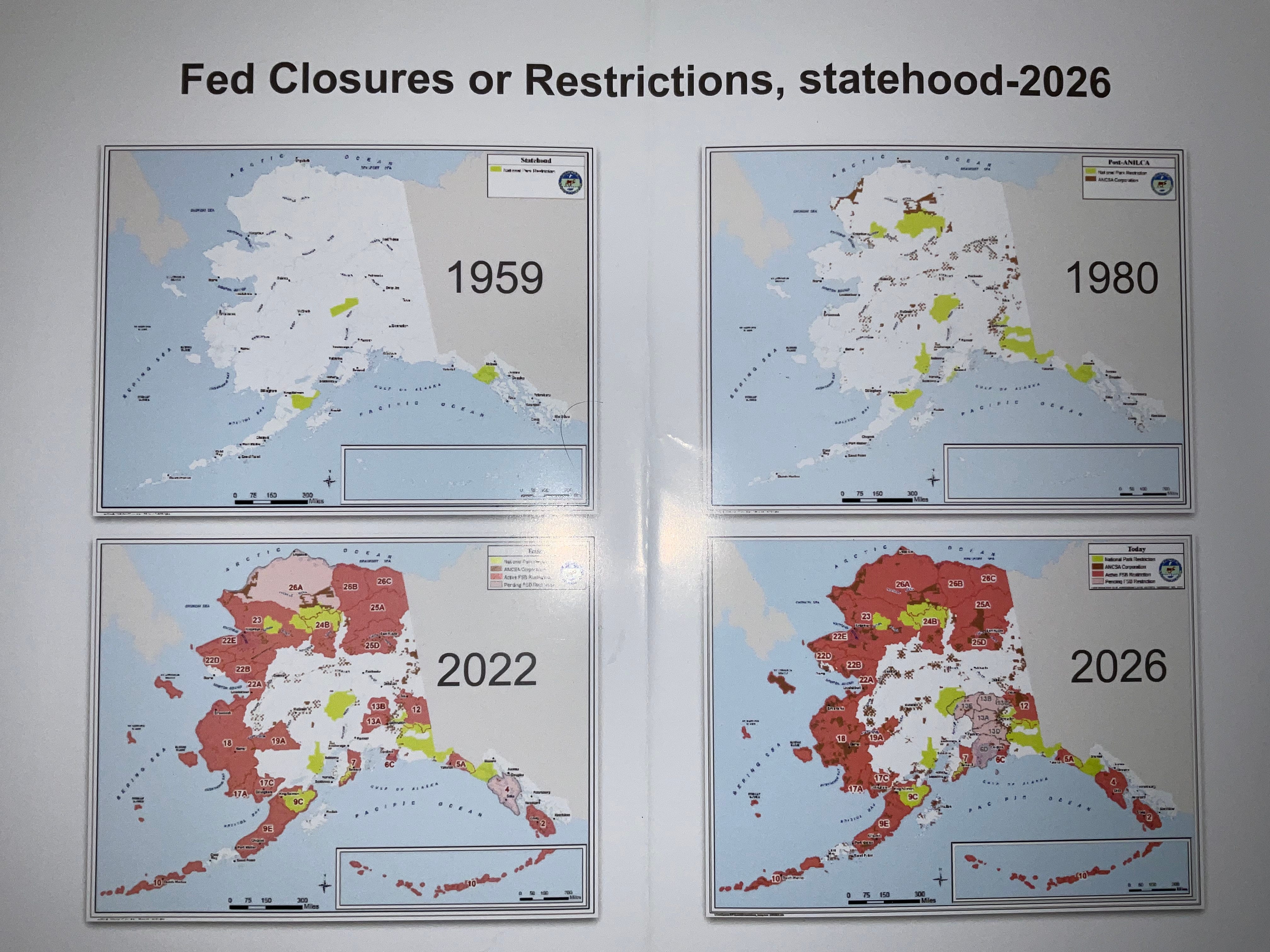
At statehood in 1959, federal hunting closures in Alaska amounted to a few specks on the map. A patch along the southeast coast. A sliver in the interior. That was it. After Congress passed ANILCA in 1980, parks and preserves expanded and federal restrictions grew, but most of the state was still open country. By 2022, active Federal Subsistence Board restrictions covered a striking share of western, northern, and interior Alaska. The projected 2026 map adds more. Pending closures keep spreading. The country the federal government has walked back from public access is now larger than the country it has left open to all Alaskans.
Subsistence matters. Rural Alaskans who depend on the land for their food deserve protection, and nothing in ADF&G’s opposition said otherwise. The state has consistently supported subsistence priority where there is a real biological shortage. That is not what is happening on the Porcupine. That is not what is happening on 25D. What is happening is a slow, map-by-map redefinition of who Alaska belongs to, decided by a federal board using criteria that have less and less to do with biology and more to do with preference.
This is the same pattern I described yesterday. Federal agencies making decisions our own experts oppose, piling up over decades until the cumulative effect is a different Alaska than the one we were promised. On land, it is withdrawals that were supposed to be temporary and have lasted fifty years. On hunting, it is closures with no biological basis that keep expanding anyway. Different agencies, different statutes, same result. Alaskans lose ground.
And ADF&G, an agency with decades of institutional knowledge about this state’s wildlife, is increasingly treated as just one more commenter in a federal docket. Our biologists know this country better than anyone alive. Their professional judgment gets acknowledged and then ignored. That is not how a federal system is supposed to work, especially in a state whose Statehood Act specifically guaranteed us the management of fish and game.
A hunting closure is not an abstraction. It tells a family from Wasilla that the country their uncle flew them into as a kid is no longer theirs to visit with a rifle. It tells a young Alaskan just getting into the woods that the best ground is reserved for someone else. It tells a commercial guide, and the small rural economies that depend on him, to find another line of work.
The Federal Subsistence Board meets again soon. More closures are on the docket. Public comment is open, and the Department of the Interior does read the record. You can find the schedule and comment portal at doi.gov/subsistence. Show up. Write in. Tell the Board what a closure on the Sheenjek or Birch Creek means for your family, your community, your freezer.
The promise of 1959 was not that Alaska would slowly become a patchwork of restricted zones managed from Washington, with our biologists overruled and our citizens crowded off the best hunting country. That promise has been chipped away, closure by closure, until the country itself looks different on paper than it did a generation ago.
Finishing the land transfer is one half of keeping the deal. Defending access to the country we already share is the other.
If we want our grandchildren to hunt the same Alaska we did, this is the time to say so.